
The SSC CGL syllabus has two tiers. Tier 1 tests Reasoning, General Awareness, Quantitative Aptitude and English: 25 questions and 50 marks each, 200 in all. Tier 2 Paper-I has Maths and Reasoning (180 marks), English and General Awareness (210), a qualifying Computer Knowledge Test and a typing test (DEST). Statistics and Finance and Economics papers (200 marks each) are only for a few posts.
SSC CGL Syllabus 2027 at a Glance
| Tier | Subjects | Questions and marks | Best book |
|---|---|---|---|
| Tier 1 | General Intelligence and Reasoning | 25 questions, 50 marks | R.S. Aggarwal, A Modern Approach to Verbal & Non-Verbal Reasoning |
| Tier 1 | General Awareness | 25 questions, 50 marks | Lucent’s General Knowledge 2027 |
| Tier 1 | Quantitative Aptitude | 25 questions, 50 marks | R.S. Aggarwal, Quantitative Aptitude |
| Tier 1 | English Comprehension | 25 questions, 50 marks | Neetu Singh, English for General Competitions Vol. 1 |
| Tier 1 | All four (previous papers) | 100 questions, 200 marks | Disha 33 Topic-wise SSC CGL Tier I PYQs |
| Tier 2 Paper-I, Section-I | Mathematical Abilities + Reasoning | 30 + 30 questions, 180 marks | The same Quant and Reasoning books |
| Tier 2 Paper-I, Section-II | English Language + General Awareness | 45 + 25 questions, 210 marks | The same English and GA books |
| Tier 2 Paper-I, Section-III | Computer Knowledge Test | 20 questions, 60 marks (qualifying) | No book needed: the topic list below |
| Tier 2 Paper-I, Section-IV | Data Entry Speed Test (DEST) | 15 minutes of typing (qualifying) | Daily typing practice |
| Tier 2 Paper-II | Statistics (JSO and Statistical Investigator Gr-II only) | 100 questions, 200 marks | Your graduation statistics textbook |
| Tier 2 Paper-III | Finance and Economics (AAO posts only) | 100 questions, 200 marks | Graduation accounts and economics textbooks |
By PrepPick Editorial Team · Last updated 3 November 2026
SSC CGL 2026 notice re-read on 3 Nov 2026. Book listings checked on 3 Nov 2026.
How we checked this page: every topic, mark and rule below comes from SSC’s CGL 2026 notice, with paragraph numbers so you can check it yourself. Topic-weightage figures are coaching sites’ estimates, named where we use them. Our methodology · About PrepPick
Official syllabus PDF: the SSC CGL 2026 notice on ssc.gov.in. The syllabus is in para 13.10 (Tier-I) and para 13.11 (Tier-II). SSC hasn’t published a CGL 2027 notice yet, so the 2026 notice is the one to study from.
The SSC CGL syllabus isn’t a separate document. SSC sets it out inside its exam notice, and for 2026 that is the Notice of Combined Graduate Level Examination, 2026, published on 21 May 2026. Marks, timing and merit rules are explained in more depth on our SSC CGL exam pattern page.
Which papers you take, and how they’re marked
| Tier | Paper | Subjects | Who takes it |
|---|---|---|---|
| Tier-I | One paper | A. General Intelligence and Reasoning · B. General Awareness · C. Quantitative Aptitude · D. English Comprehension | All candidates |
| Tier-II | Paper-I, Session-I | Section-I: Mathematical Abilities + Reasoning and General Intelligence · Section-II: English Language and Comprehension + General Awareness · Section-III: Computer Knowledge Test | All posts |
| Tier-II | Paper-I, Session-II | Section-IV: Data Entry Speed Test (DEST) | All posts |
| Tier-II | Paper-II | Statistics | Only candidates shortlisted for Junior Statistical Officer (JSO) and Statistical Investigator Grade-II |
| Tier-II | Paper-III | General Studies (Finance and Economics) | Only candidates shortlisted for Assistant Audit Officer and Assistant Accounts Officer |
Source: SSC CGL 2026 notice, paras 13.8, 13.9, 13.9.3 and 13.9.5.
| Paper | Questions and marks | Time | Wrong answer |
|---|---|---|---|
| Tier-I | 100 questions, 200 marks (25 and 50 per subject) | 1 hour, with a 15-minute timer per subject | −0.50 |
| Tier-II Paper-I, Section-I | 60 questions (30 Maths, 30 Reasoning), 180 marks | 1 hour, 30 minutes per subject | −1 |
| Tier-II Paper-I, Section-II | 70 questions (45 English, 25 GA), 210 marks | 1 hour: 40 minutes English, 20 minutes GA | −1 |
| Tier-II Paper-I, Section-III | 20 questions, 60 marks (qualifying) | 15 minutes | −1 |
| Tier-II Paper-I, Section-IV (DEST) | One data-entry task (qualifying) | 15 minutes | – |
| Tier-II Papers II and III | 100 questions, 200 marks each | 2 hours each | −0.50 |
Source: paras 13.8, 13.9 and 13.9.8. Candidates eligible for a scribe get extra time, set out in the same tables.
Qualifying marks (para 16.1): in Tier-I and in each of Sections I, II and III of Tier-II Paper-I and Papers II and III, you need at least 30% (UR), 25% (OBC/EWS) or 20% (all other categories). For DEST the limit is on errors: at most 20% (UR), 25% (OBC/EWS) or 30% (others) (para 16.2).
What counts for merit: Tier-I only shortlists you for Tier-II (para 16.3). The final merit list uses Tier-II alone (para 16.10): Sections I and II of Paper-I, plus Paper-II or Paper-III for those posts. The Computer Knowledge Test and DEST are qualifying (paras 16.6 and 16.11).
2026 dates: Tier-I (computer-based) ran from 30 September to 30 October 2026, per SSC’s Important Notice of 12 Sep 2026. The notice cover gives Tier-II as “December, 2026”, tentatively.
Official syllabus documents: which one to trust
| Document | What it is | Use it? |
|---|---|---|
| Notice of CGL Examination, 2026 (21.05.2026, 132 pages) | Current scheme. The indicative syllabus is in para 13.10 (Tier-I) and para 13.11 (Tier-II) | Yes, this is the current document |
| SSC “CGL syllabus” PDF (7 pages) | Headed “Combined Graduate Level Examination, 2024”. Has no Paper-III | No. CGL 2024 scheme, superseded, though it still ranks high in search |
| Notice of CGL Examination, 2025 (09.06.2025, 113 pages) | Previous cycle | Only to compare changes |
Watch the 2025 link. Some sites link
…/Notice_of_adv_cgl_2025.pdfas the 2025 notice. That address now serves the 2026 notice. The genuine 2025 notice is the 09062025 file above.
Some coaching pages still describe Tier-II in “modules” (Module I, Module II), the older scheme’s labels; the 2026 notice uses Sections I–IV. Others mention only Paper-II as a specialist paper, though the 2026 notice adds Paper-III.
Tier-I syllabus, subject by subject (para 13.10)
Tier-I questions are objective multiple choice, set in English and Hindi except English Comprehension (para 13.8.1). Level (para 13.10.5): Reasoning, General Awareness and English are pitched at graduation level; Quantitative Aptitude at 10th-standard level.
General Intelligence and Reasoning
Verbal and non-verbal questions (para 13.10.1). Book: R.S. Aggarwal’s Verbal & Non-Verbal Reasoning; more options in our SSC CGL reasoning books guide.
| Group | Topics in the notice |
|---|---|
| Verbal and number | Analogy (semantic, symbolic/number) · Classification · Series (semantic, number) · Coding and decoding · Numerical and symbolic operations · Problem solving · Word building · Trends |
| Figure-based | Figural analogy, classification and series · Space orientation and visualisation · Venn diagrams · Punched hole / pattern folding and unfolding · Figural pattern folding and completion · Embedded figures |
| Matching and indexing | Indexing · Address matching · Date and city matching · Classification of centre codes and roll numbers · Small and capital letters/numbers coding, decoding and classification |
| Thinking skills | Drawing inferences · Critical thinking · Emotional intelligence · Social intelligence |
| Also listed | Similarities and differences, analysis, judgement, decision making, visual memory, discrimination, observation, relationship concepts, arithmetical reasoning, arithmetic number series, non-verbal series, statement and conclusion, syllogistic reasoning, among others |
General Awareness
There is no fixed topic list (para 13.10.2). The scope is:
| Scope in the notice | What that means in practice |
|---|---|
| The environment around you and its application to society | Environment, ecology, government schemes |
| Current events | National and international news |
| Everyday observation and experience in their scientific aspect | School-level physics, chemistry and biology |
| India and its neighbouring countries: History, Culture, Geography, Economic Scene, General Policy and scientific developments | History, art and culture, geography, economy, polity |
The right-hand column is our reading of the notice’s wording, not SSC’s list. Books: our GA books for SSC CGL and Lucent GK book guides.
Quantitative Aptitude
“The ability of appropriate use of numbers and number sense” (para 13.10.3). Book guide: books for SSC CGL maths.
| Area | Topics |
|---|---|
| Arithmetic | Whole numbers, decimals, fractions and relationships between numbers · Percentage · Ratio and proportion · Square roots · Averages · Interest · Profit and loss · Discount · Partnership business · Mixture and alligation · Time and distance · Time and work |
| Algebra | Basic algebraic identities of school algebra and elementary surds · Graphs of linear equations |
| Geometry | Triangle and its various kinds of centres · Congruence and similarity of triangles · Circle and its chords, tangents, angles subtended by chords · Common tangents to two or more circles |
| Mensuration | Triangle · Quadrilaterals · Regular polygons · Circle · Right prism · Right circular cone · Right circular cylinder · Sphere · Hemispheres · Rectangular parallelepiped · Regular right pyramid with triangular or square base |
| Trigonometry | Trigonometric ratio · Degree and radian measures · Standard identities · Complementary angles · Heights and distances |
| Data interpretation | Histogram · Frequency polygon · Bar diagram · Pie chart |
English Comprehension
The notice gives no Tier-I topic list. It tests “Candidates’ ability to understand correct English, his basic comprehension and writing ability, etc.” (para 13.10.4). In practice the Tier-II list below shows the question types. Book guide: SSC CGL English books, or start with Neetu Singh’s English book.
Tier-II syllabus (para 13.11)
Paper-I is compulsory for all posts. Its two sessions are on the same day (para 13.9.5), and you must qualify every section separately (para 13.9.6). Level (para 13.11.8): Mathematical Abilities at Matriculation level, English at 10+2 level, Papers II and III at graduation level.
Section-I: Mathematical Abilities (para 13.11.1)
| Area | Topics |
|---|---|
| Number systems | Computation of whole numbers, decimals and fractions · Relationship between numbers |
| Fundamental arithmetical operations | Percentages · Ratio and proportion · Square roots · Averages · Interest (simple and compound) · Profit and loss · Discount · Partnership business · Mixture and alligation · Time and distance · Time and work |
| Algebra | Basic algebraic identities of school algebra and elementary surds (simple problems) · Graphs of linear equations |
| Geometry | Triangle and its various kinds of centres · Congruence and similarity of triangles · Circle and its chords, tangents, angles subtended by chords · Common tangents to two or more circles |
| Mensuration | Triangle · Quadrilaterals · Regular polygons · Circle · Right prism · Right circular cone · Right circular cylinder · Sphere · Hemispheres · Rectangular parallelepiped · Regular right pyramid with triangular or square base |
| Trigonometry | Trigonometric ratios · Complementary angles · Heights and distances (simple problems only) · Standard identities such as sin²θ + cos²θ = 1 |
| Statistics and probability | Histogram, frequency polygon, bar diagram, pie chart · Mean, median, mode, standard deviation · Calculation of simple probabilities |
Section-I: Reasoning and General Intelligence (para 13.11.2)
| Group | Topics in the notice |
|---|---|
| Verbal and number | Analogy, classification and series (semantic, symbolic/number) · Symbolic and numerical operations · Trends · Problem solving · Word building · Coding and decoding |
| Figure-based | Figural analogy, classification and series · Space orientation · Venn diagrams · Punched hole / pattern folding and unfolding · Figural pattern folding and completion · Embedded figures |
| Thinking skills | Drawing inferences · Critical thinking · Emotional intelligence · Social intelligence |
| Open-ended | “Other sub-topics, if any” |
Section-II: English Language and Comprehension (para 13.11.3)
| Type | Topics |
|---|---|
| Vocabulary | Synonyms/homonyms · Antonyms · Spellings and detecting misspelt words · Idioms and phrases · One-word substitution |
| Grammar | Spot the error · Fill in the blanks · Improvement of sentences · Active/passive voice · Direct/indirect narration |
| Structure | Shuffling of sentence parts · Shuffling of sentences in a passage |
| Reading | Cloze passage · Comprehension passage |
For comprehension, three or more paragraphs are given. At least one is a simple one based on a book or a story; the other two are on current affairs, based on a report or an editorial.
Section-II: General Awareness (para 13.11.4)
The same scope as Tier-I: the environment and its application to society, current events, everyday science, and India and its neighbouring countries.
Section-III: Computer Knowledge Test (para 13.11.5)
Compulsory for all posts but qualifying (para 13.9.9(a)). 20 questions, 60 marks, 15 minutes.
| Area | Topics |
|---|---|
| Computer basics | Organisation of a computer · CPU · Input/output devices · Computer memory and memory organisation · Backup devices · Ports · Windows Explorer · Keyboard shortcuts |
| Software | Windows operating system · Basics of Microsoft Office such as MS Word, MS Excel and PowerPoint |
| Internet and e-mail | Web browsing and searching · Downloading and uploading · Managing an e-mail account · e-Banking |
| Networking and cyber security | Networking devices and protocols · Network and information security threats (hacking, virus, worms, Trojans) and preventive measures |
Section-IV: Data Entry Speed Test (DEST)
Session-II is only the DEST: “a passage of about 2000 (two thousand) key depressions for a duration of 15 (fifteen) minutes” (para 13.9.10.2). It is compulsory for all posts but qualifying (para 13.9.10.3). Some PwBD candidates can be exempted with a certificate (para 13.9.10.6).
Posts with higher standards. The notice’s lists end in “etc.”, so they aren’t complete:
- Higher CKT and DEST standards (para 13.9.9(b)): Assistant Section Officer in CSS, MEA and AFHQ; Assistant in SFIO; Assistant (GSI) in the Ministry of Mines; Assistant in the India Meteorological Department; Inspector (CGST and Central Excise), Inspector (Preventive Officer), Inspector (Examiner) and Executive Assistant in CBIC; Postal Assistant/Sorting Assistant.
- Higher DEST standards (para 13.9.10.4): Tax Assistant in CBIC and CBDT, and UDC/SSA in the Central Bureau of Narcotics, plus the posts above.
Paper-II: Statistics (para 13.11.6)
Only for candidates shortlisted for JSO and Statistical Investigator Grade-II. Graduation level.
| Area | Topics |
|---|---|
| Statistical data | Primary and secondary data · Methods of data collection · Tabulation · Graphs and charts · Frequency distributions and their diagrammatic presentation |
| Central tendency | Mean, median, mode · Quartiles, deciles, percentiles |
| Dispersion | Range, quartile deviation, mean deviation, standard deviation · Measures of relative dispersion |
| Moments, skewness, kurtosis | Types of moments and their relationship · Meaning and measures of skewness and kurtosis |
| Correlation and regression | Scatter diagram · Simple correlation coefficient · Simple regression lines · Spearman’s rank correlation · Association of attributes · Multiple regression · Multiple and partial correlation (three variables only) |
| Probability theory | Definitions of probability · Conditional and compound probability · Independent events · Bayes’ theorem |
| Random variables and distributions | Probability functions · Expectation, variance and higher moments · Binomial, Poisson, normal and exponential distributions · Joint distribution of two discrete random variables |
| Sampling theory | Population and sample · Parameter and statistic · Sampling and non-sampling errors · Probability and non-probability sampling techniques · Sampling distribution (statement only) · Sample size decisions |
| Statistical inference | Point and interval estimation · Properties of a good estimator · Methods of moments, maximum likelihood and least squares · Testing of hypothesis · Small and large sample tests · Z, t, chi-square and F tests · Confidence intervals |
| Analysis of variance | One-way and two-way classified data |
| Time series | Components of time series · Trend by different methods · Seasonal variation by different methods |
| Index numbers | Meaning, construction problems, types and formulae · Base shifting and splicing · Cost of living index · Uses |
Paper-III: General Studies (Finance and Economics) (para 13.11.7)
Only for candidates shortlisted for Assistant Audit Officer and Assistant Accounts Officer. New in CGL 2026; the 2025 Tier-II had Papers I and II only. Graduation level.
| Part | Topics |
|---|---|
| A: Finance and Accounts (80 marks) | Financial accounting: nature, scope, limitations, basic concepts and conventions, GAAP · Single and double entry; books of original entry; journal; ledgers; trial balance; bank reconciliation; rectification of errors · Manufacturing, trading, profit and loss appropriation accounts; balance sheet; capital vs revenue expenditure · Depreciation; valuation of inventories · Non-profit organisations’ accounts; receipts and payments, income and expenditure accounts · Bills of exchange; self-balancing ledgers |
| B: Economics and Governance (120 marks) | CAG: constitutional provisions, role and responsibility · Finance Commission · Basic economics and microeconomics; production possibilities curve · Demand and supply, elasticity, consumer behaviour · Production and cost; returns to scale · Market forms and price determination · Indian economy: sectors, national income, population, poverty and unemployment, infrastructure · Economic reforms since 1991 · Money and banking: monetary and fiscal policy, RBI, commercial banks, RRBs and payments banks, budget and fiscal deficits, balance of payments, FRBM Act 2003 · IT in governance |
The SSC CGL 2026 notice states both: para 16.11.2 makes the Assistant Audit Officer and Assistant Accounts Officer merit list “subject to qualifying Section-III (both modules) of Paper-I”, while para 13.9 (13.9.4.3) describes Section-III as a single Computer Knowledge Test, so follow the latest corrigendum on ssc.gov.in (none had been issued for CGL 2026 as of 26 Oct 2026).
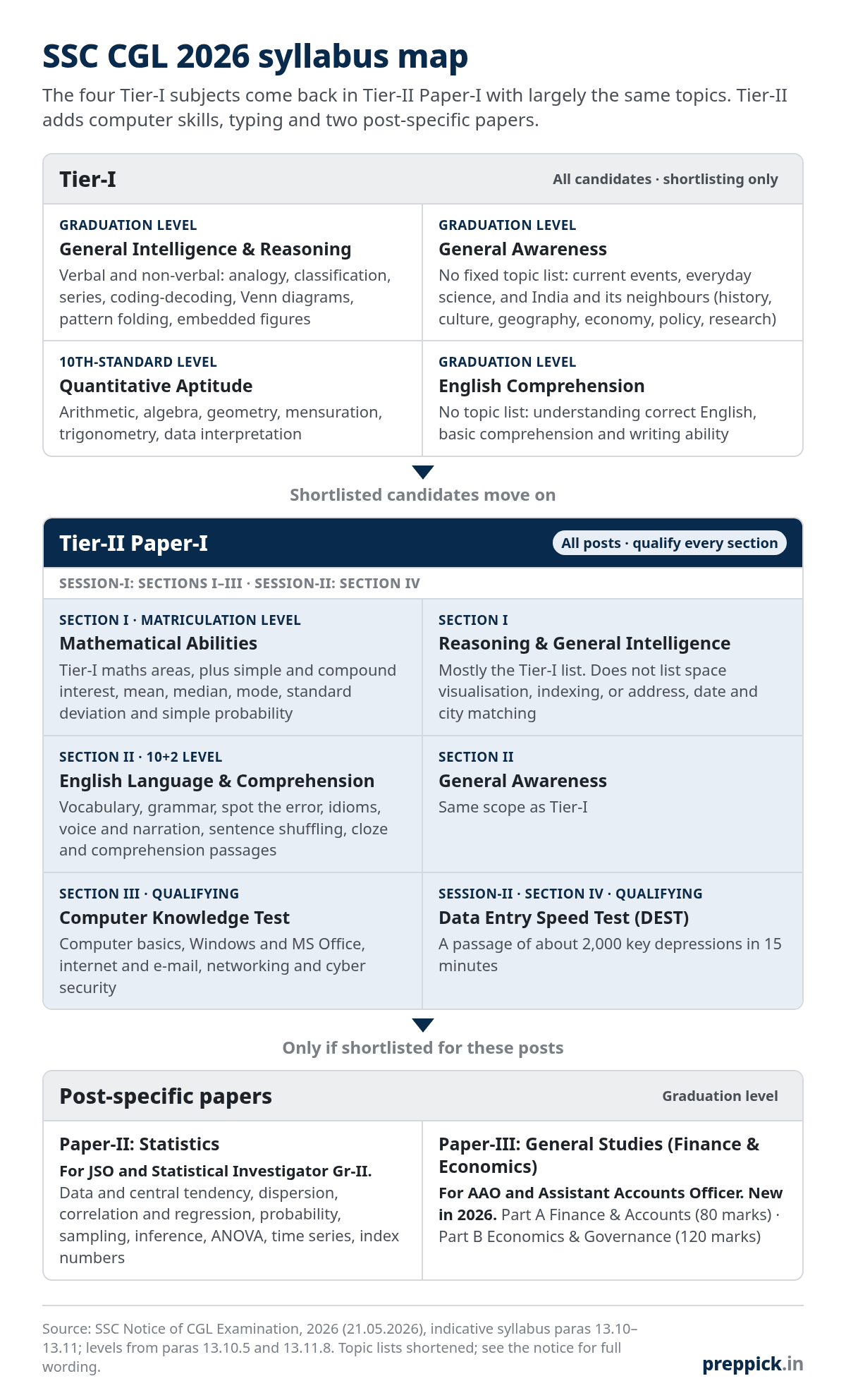
Tier-I vs Tier-II: what carries over
| Area | Tier-I | Tier-II Paper-I | Differences in the topic lists |
|---|---|---|---|
| Maths | Quantitative Aptitude (10th-standard level) | Mathematical Abilities (Matriculation level) | Tier-II names simple and compound interest, adds mean, median, mode, standard deviation and simple probability, and drops degree and radian measures |
| Reasoning | General Intelligence and Reasoning | Reasoning and General Intelligence | Tier-II drops space visualisation, indexing, address/date/city matching and centre-code classification, and adds “other sub-topics, if any” |
| English | English Comprehension (graduation level) | English Language and Comprehension (10+2 level) | Tier-II lists the question types and passages in detail |
| General Awareness | Same scope | Same scope | None |
| Computer | — | Computer Knowledge Test (qualifying) | New |
| Typing | — | DEST (qualifying) | New |
| Post-specific | — | Paper-II (Statistics), Paper-III (Finance and Economics) | New |
The four Tier-I subjects return in Tier-II with largely the same topics, so one round of preparation serves both. What changes is weight: in Tier-II, English and GA together carry 210 marks against 180 for Maths and Reasoning, and English alone has 45 questions.
High-weightage topics: what coaching estimates say
SSC publishes no topic-wise weightage; the notice gives marks per subject only. Two coaching sites publish expected questions per topic for Tier-I. They’re estimates from past papers, not official counts, and they don’t always agree:
| Subject | Topic | Adda247 estimate | Career Power estimate |
|---|---|---|---|
| English | Reading comprehension | 5–8 | 5 |
| English | Cloze test | 3–5 | 5 |
| English | Error spotting | 3–4 | 4–5 |
| English | Sentence improvement | 2–3 | 2–3 |
| GA | Current affairs | 5–7 | 4–5 |
| GA | General science | 4–6 | 4–5 |
| GA | History / Polity | 2–3 each | 3–4 each |
| Reasoning | Coding-decoding | 3–4 | 2–3 |
| Reasoning | Analogy | 2–4 | 3–4 |
| Reasoning | Series | 2–3 | 3–4 |
| Quant | Geometry | 2–3 | 3–4 |
| Quant | Algebra | 2–3 | 2–3 |
| Quant | Data interpretation | 1–2 | 3–4 |
Both lists also include blood relations, direction sense and (Adda247) seating arrangement, which the notice doesn’t name; its description of the reasoning section ends in “etc.”. To check weightage yourself, solve a topic-wise PYQ book: our SSC CGL PYQ books guide compares them.
How to plan your prep from the syllabus
- Print the notice’s syllabus pages (paras 13.10 and 13.11) and tick topics off as you finish them.
- Prepare Tier-I and Tier-II together. The four subjects overlap; add the Tier-II extras (standard deviation, probability, the full English list) from the start.
- Start with what decides merit. Sections I and II of Tier-II Paper-I count for merit; English is the biggest single block (45 questions).
- One concept book per subject, then topic-wise previous papers the same week you finish each topic.
- Don’t leave the qualifying parts to the end. Fifteen minutes of typing a day for DEST and a short run through the Computer Knowledge list cost little and can’t be crammed.
- Specialist posts: if you’re aiming for JSO or AAO, Paper-II or Paper-III adds 200 marks to your merit, so start it alongside Paper-I, not after Tier-I.
- Final phase: full timed mocks under the sectional timers, since each section closes automatically (para 13.9.5).
One book per syllabus subject
Buy one book per subject at most; two books that do the same job waste time. For editions and what to skip, see our SSC CGL books guide.
| Syllabus subject | Book | Use |
|---|---|---|
| All four Tier-I subjects (PYQs) | Disha 33 Topic-wise SSC CGL Tier I PYQs, 2nd ed. (2010–2025 papers) | Topic-wise practice with real questions |
| General Awareness | Lucent’s General Knowledge 2027 | One-volume static GK; check that the cover says 2027 |
| General Awareness (Hindi medium) | Lucent Samanya Gyan, 19th ed. | Use instead of the English Lucent |
| English (both tiers) | Neetu Singh Vol. 1, 2026 ed., or S.P. Bakshi, Objective General English | Grammar rules and practice; pick one of the two |
| Reasoning | R.S. Aggarwal, A Modern Approach to Verbal & Non-Verbal Reasoning (S.Chand, Revised Edition 2024-25) | Verbal and figure-based reasoning; the Amazon title says “2026-2027”, but the listing details and S.Chand’s site say 2024-25, S.Chand’s current English edition |
| Quantitative Aptitude / Maths | R.S. Aggarwal, Quantitative Aptitude (S.Chand) | Arithmetic, algebra, geometry, mensuration, trigonometry from the basics |
| Computer Knowledge, DEST | None | The topic list above and daily typing practice |
SSC CGL सिलेबस: हिंदी में सारांश
SSC CGL का सिलेबस SSC के परीक्षा नोटिस (21 मई 2026) में दिया गया है। टियर-I का सिलेबस पैरा 13.10 में है और टियर-II का पैरा 13.11 में।
| अंग्रेज़ी | हिंदी |
|---|---|
| General Intelligence and Reasoning | सामान्य बुद्धि और तर्कशक्ति |
| General Awareness | सामान्य जागरूकता |
| Quantitative Aptitude / Mathematical Abilities | मात्रात्मक योग्यता / गणितीय क्षमता |
| English Comprehension | अंग्रेज़ी बोध |
| Computer Knowledge Test | कंप्यूटर ज्ञान परीक्षा |
| Data Entry Speed Test (DEST) | डेटा एंट्री स्पीड टेस्ट |
| Statistics | सांख्यिकी |
| General Studies (Finance and Economics) | सामान्य अध्ययन (वित्त और अर्थशास्त्र) |
- टियर-I में चार विषय हैं, हर विषय में 25 प्रश्न और 50 अंक। अंग्रेज़ी को छोड़कर सभी प्रश्न अंग्रेज़ी और हिंदी दोनों में आते हैं।
- टियर-II का पेपर-I सभी पदों के लिए अनिवार्य है। कंप्यूटर ज्ञान परीक्षा और DEST सिर्फ़ क्वालिफ़ाइंग हैं।
- पेपर-II (सांख्यिकी) केवल JSO और सांख्यिकी अन्वेषक ग्रेड-II के लिए है। पेपर-III केवल सहायक लेखा परीक्षा अधिकारी और सहायक लेखा अधिकारी के लिए है।
- टियर-I में गणित 10वीं स्तर का है; तर्कशक्ति, सामान्य जागरूकता और अंग्रेज़ी स्नातक स्तर के हैं। टियर-II में गणित मैट्रिक स्तर, अंग्रेज़ी 10+2 स्तर, और पेपर-II व पेपर-III स्नातक स्तर के हैं।
- पेपर-III के दो भाग हैं: भाग A वित्त और लेखा (80 अंक), भाग B अर्थशास्त्र और शासन (120 अंक)।
20 अक्टूबर 2026 तक हमें 2026 नोटिस का हिंदी संस्करण नहीं मिला। ऊपर दिए हिंदी नाम हमारा अनुवाद हैं। आधिकारिक जानकारी के लिए अंग्रेज़ी नोटिस देखें।
When the CGL 2027 notice arrives: what to re-check
SSC hasn’t published a CGL 2027 notice or syllabus. The newest notice-board record we checked was dated 23 Oct 2026, and SSC’s tentative 2026–27 calendar (8 Jan 2026) has no CGL 2027 entry. When the 2027 notice appears, check:
- whether Paper-III and the sectional timers stay;
- the post lists for Paper-II, Paper-III and the higher CKT/DEST standards;
- whether the Section-III wording in para 16.11.2 is corrected;
- the topic lists in the indicative syllabus paras.
Frequently asked questions
What are the subjects in SSC CGL?
Tier-I has General Intelligence and Reasoning, General Awareness, Quantitative Aptitude and English Comprehension. Tier-II Paper-I has Mathematical Abilities, Reasoning, English, General Awareness, a Computer Knowledge Test and a Data Entry Speed Test. Some posts also take Statistics or Finance and Economics.
Has the SSC CGL 2027 syllabus been released?
No. SSC hasn’t published a CGL 2027 notice, and its 2026–27 calendar has no CGL 2027 entry. Study from the 2026 notice until it does.
Is the SSC CGL Tier-I and Tier-II syllabus the same?
Mostly. The same four areas appear in both. Tier-II adds computer knowledge and typing for everyone, a few maths topics (standard deviation, probability), and specialist papers for JSO, Statistical Investigator Grade-II and AAO posts.
How many marks is SSC CGL Tier-II Paper-I?
Section-I (Maths and Reasoning) is 180 marks, Section-II (English and GA) 210 marks and Section-III (Computer Knowledge) 60 marks, at 3 marks a question. Section-III and the DEST are qualifying; merit uses Sections I and II. See our exam pattern page.
What are the minimum qualifying marks in SSC CGL?
30% for UR, 25% for OBC/EWS and 20% for other categories, in Tier-I and in each scored section of Tier-II (para 16.1). In DEST, errors may not exceed 20%, 25% or 30% respectively (para 16.2).
What is the SSC CGL typing test (DEST)?
A 15-minute data-entry test of about 2,000 key depressions, held in Session-II of Tier-II Paper-I. It is compulsory for all posts but qualifying, with higher standards for posts such as Tax Assistant and Assistant Section Officer.
Which papers are only for JSO and AAO posts?
Paper-II (Statistics) is for JSO and Statistical Investigator Grade-II. Paper-III (General Studies: Finance and Economics) is for Assistant Audit Officer and Assistant Accounts Officer. Each is 100 questions and 200 marks.
Where can I download the official SSC CGL syllabus PDF?
Download the CGL 2026 notice from ssc.gov.in; the syllabus is in paras 13.10 and 13.11. The separate “CGL syllabus” PDF on SSC’s site is the superseded 2024 version.
Is the SSC CGL syllabus available in Hindi?
The questions are bilingual except the English sections. As of 20 Oct 2026, SSC’s notice board had no Hindi version of the 2026 notice; the Hindi summary above is our own.
Are Tier-I marks counted in the final merit?
No. Tier-I is used only to shortlist candidates for Tier-II (para 16.3). The final merit list uses Tier-II alone (para 16.10).
Is there an official topic-wise weightage for SSC CGL?
No. The notice gives questions and marks per subject only. Coaching sites such as Adda247 and Career Power publish estimates, summarised above, and they don’t always agree.
Which books cover the SSC CGL syllabus?
One concept book per subject plus a topic-wise PYQ book: the at-a-glance table above lists them, and our SSC CGL books guide compares the alternatives.
Sources
- SSC: Notice of CGL Examination, 2026 (21.05.2026; re-read 3 Nov 2026)
- SSC: Important Notice, CGL 2026 Tier-I schedule (12.09.2026)
- SSC: Tentative calendar of examinations 2026–27 (08.01.2026)
- SSC: Notice of CGL Examination, 2025 (09.06.2025)
- SSC: CGL syllabus PDF, 2024 scheme (superseded); previous year question paper page
- S.Chand: A Modern Approach to Verbal & Non-Verbal Reasoning, Fully Revised Video Edition 2024-25
- Topic-weightage estimates and pages compared on 3 Nov 2026: Adda247, SSC CGL Syllabus 2026; Career Power, SSC CGL Syllabus 2026; PW Store, SSC CGL Syllabus 2026
More guides: SSC CGL exam pattern · SSC CGL books · maths books · reasoning books · English books · GA books · PYQ books