
The NEET syllabus for 2027 hasn’t been released yet: as of 3 Nov 2026, NMC had notified nothing new, so study from the official NEET (UG)-2026 syllabus, which NTA says is unchanged from 2025. It has 50 units (Physics 20, Chemistry 20, Biology 10), tested through 180 compulsory questions for 720 marks. Below you’ll find every unit with its key topics, the official PDF, and a unit-to-NCERT chapter map.
NEET Syllabus 2027 at a Glance
| Subject | Units in the official syllabus | Questions and marks (2026 pattern) | Best book for this part |
|---|---|---|---|
| Physics | 20 (Units 1–20, one list) | 45 questions, 180 marks | MTG NEET PYQ 39 Years Physics; for concepts, H. C. Verma Concepts of Physics Part 1 |
| Chemistry | 20 (Physical 1–8, Inorganic 9–12, Organic 13–20) | 45 questions, 180 marks | MTG Objective NCERT at your Fingertips Chemistry, 2026-27 |
| Biology (Botany and Zoology) | 10 (Units 1–10) | 90 questions, 360 marks | NCERT Biology Class 11 and Class 12, then MTG Fingertips Biology, 2026-27 |
| Past papers, all three subjects | All 50 units | 180 questions, 720 marks, 180 minutes | MTG NEET PYQ 39 Years (1988–2026), set of 3 |
| Hindi medium | Same 50 units | Same paper, English–Hindi booklet | MTG Fingertips Biology (Hindi) |
More options for each subject: best NEET preparation books.
By PrepPick Editorial Team · Last updated 3 November 2026
Status pages (NMC’s What’s New, neet.nta.nic.in and NTA’s exam calendar), the official syllabus PDF and the 2026 information bulletin were rechecked on 3 Nov 2026.
How we checked this page: the unit list and key topics come from the official NMC syllabus for NEET (UG)-2026, and the pattern and marking from NTA’s 2026 information bulletin (Chapter 4). We don’t use coaching-site chapter lists, and we name the source when we mention another site’s claim. Our methodology · About PrepPick
Has the NEET 2027 syllabus been released?
Not yet. As of 3 Nov 2026, NMC has not notified a NEET (UG) 2027 syllabus. The latest official syllabus is the NEET (UG)-2026 syllabus (NMC/UGMEB, 22 December 2025), and NTA confirmed it was unchanged from 2025. This page follows that syllabus. We will update it when NMC publishes the 2027 version.
We checked NMC’s “What’s New” list (latest item 30 Oct 2026, nothing on the NEET syllabus), the NEET site (only 2026 items) and NTA’s revised exam calendar of 26 Oct 2026, which runs to April 2027 and doesn’t list NEET. For reference, the 2026 syllabus notice came on 22 December 2025.
What could change for NEET 2027
| Item | Status on 3 Nov 2026 | What it means for you |
|---|---|---|
| Syllabus | No 2027 notice; 2026 syllabus unchanged from 2025 | Study the 50 units below |
| Information bulletin | Not out; not on NTA’s calendar to April 2027 | Pattern, dates and eligibility for 2027 are not announced yet |
| Exam mode (pen and paper or computer-based) | Not decided | The syllabus doesn’t depend on the mode |
On computer-based testing (CBT): the then Education Minister announced on 15 May 2026 that NEET would move to CBT from 2027 (Hindustan Times). Since then the Centre has told the Supreme Court that no final decision has been taken: on 4 August (Times of India) and again on 18 September 2026, when it said the switch was still under “active consideration” (The Hindu). Hindustan Times later reported that NEET-UG 2027 may stay pen and paper, after the Nilekani-led task force’s term was extended to 27 January 2027. Aakash’s syllabus page states that NEET 2027 “moves to CBT mode”; the government’s statements in court don’t support that yet. Wait for NTA’s 2027 bulletin.
NEET exam pattern and marking (2026)
| Subject | Questions | Marks |
|---|---|---|
| Physics | 45 | 180 |
| Chemistry | 45 | 180 |
| Biology (Botany and Zoology) | 90 | 360 |
| Total | 180 compulsory questions | 720 marks, 180 minutes |
Marking (Chapter 4 §3): +4 for a correct answer, −1 for a wrong answer, 0 for a question left blank. If NTA finds more than one correct option, anyone who marked a correct one gets 4 marks; if all options are correct, everyone who attempted it gets 4; if a question is dropped or has no correct option, every candidate gets 4 marks.
Source: NEET (UG)-2026 Information Bulletin, Chapter 4 §2–3. The 2026 paper ran from 2:00 to 5:00 pm and was offered in 13 languages. NTA re-held the 2026 exam on 21 June 2026 and declared results on 16 July 2026. The 2027 pattern will be confirmed in the 2027 bulletin.
Who sets the NEET syllabus: NMC or NTA?
| Body | Role |
|---|---|
| NMC (National Medical Commission), through its Under Graduate Medical Education Board (UGMEB) | Finalises and notifies the syllabus. The UGMEB “has finalized the NEET (UG)-2026 Syllabus” (public notice, 22 Dec 2025) |
| NTA (National Testing Agency) | Publishes the syllabus on its NEET site and runs the exam. Its 2026 bulletin says “NMC … has notified the syllabus of NEET (UG) – 2026” |
The official syllabus PDF (and the link to avoid)
| Document | Use it? |
|---|---|
| NTA: “Syllabus for NEET (UG)-2026 Examination” page on neet.nta.nic.in | Yes, start here. NTA’s own page for the current syllabus, with the PDF link below. Rechecked 3 Nov 2026 |
| NMC: Updated syllabus for NEET (UG)-2026 (NMC “What’s New”, 23/12/2025) | Yes, the official NMC copy |
| NTA: Syllabus for NEET (UG)-2026 Examination (18 pages, with NMC’s letter of 22-12-2025) | Yes, the same syllabus as hosted by NTA |
| The NEET site’s generic “Syllabus” link (…/20260102588210790.pdf) | No. Its first line reads “SYLLABUS FOR NEET (UG) – 2025”. The topics are the same, but the label is stale |
| The NMC link printed in the 2026 bulletin’s FAQ | No. It now returns an error (404) |
Did the syllabus change for 2026?
No. The NEET (UG)-2026 Information Bulletin answers this directly: “No, there is no change in the syllabus of NEET (UG) – 2026 with respect to the previous year.”
We compared the 2025 and 2026 syllabus texts word by word and found no differences beyond the year in the heading and office footer lines (text only; diagrams weren’t compared). So any list of “deleted chapters for 2027” has no official basis yet.
One wording fix to note: Biology Unit 2 says “of an insect(Frog)”. The bulletin’s FAQ says it “should be read as of an insect and a frog”.
All 50 units: the official NEET syllabus
| Subject | Units | Grouping in the syllabus |
|---|---|---|
| Physics | 20 | One list |
| Chemistry | 20 | Physical (Units 1–8), Inorganic (Units 9–12), Organic (Units 13–20) |
| Biology | 10 | One list |
The syllabus is organised by units only; it has no chapter level and no Class 11/12 split. Each unit carries a list of sub-topics. The “Key topics” column below condenses them in our words; the full wording is in the NMC PDF.
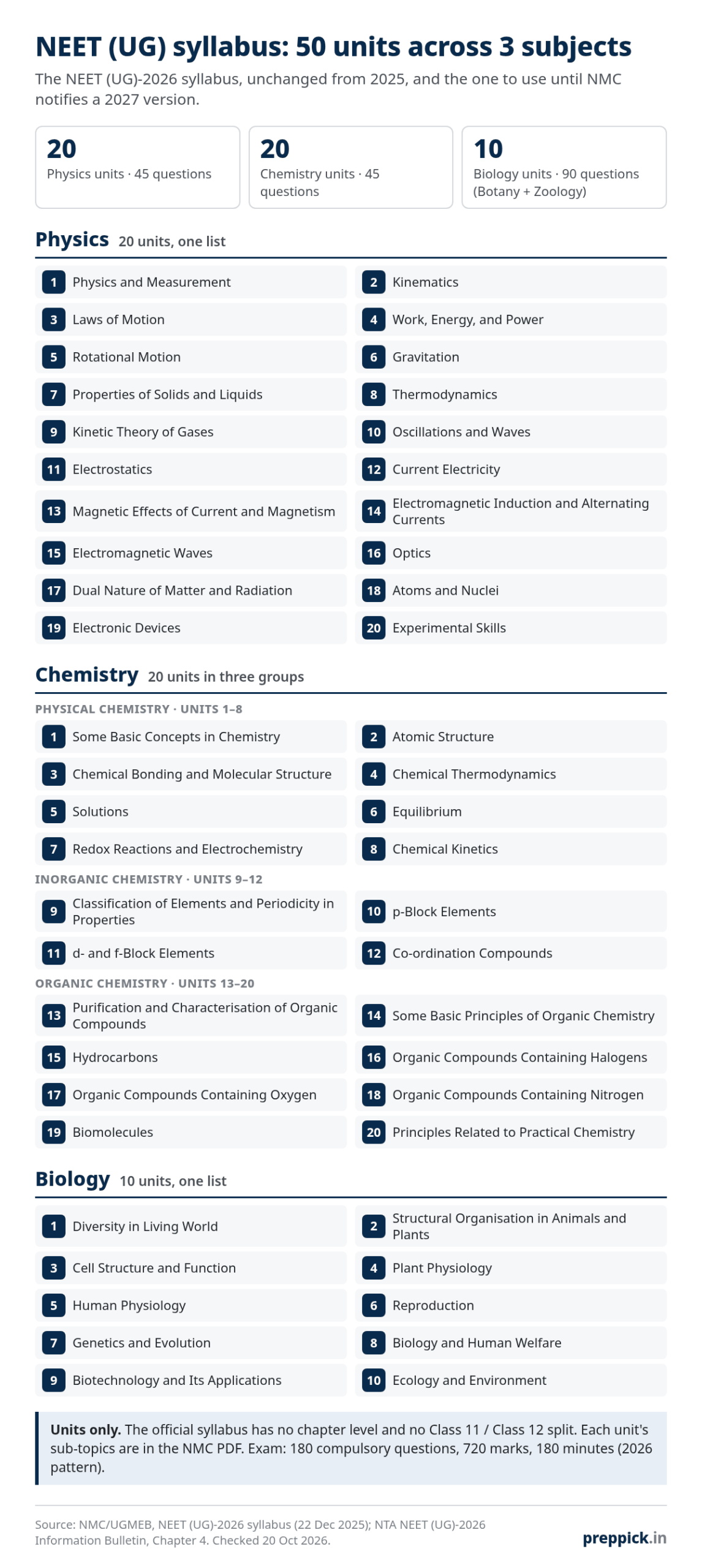
NEET Physics syllabus (20 units)
| Unit | Title | Key topics |
|---|---|---|
| 1 | Physics and Measurement | SI units, least count, significant figures, errors, dimensional analysis |
| 2 | Kinematics | Motion in a straight line and its graphs, vectors, relative velocity, projectile and uniform circular motion |
| 3 | Laws of Motion | Newton’s laws, momentum and impulse, friction, circular motion on level and banked roads |
| 4 | Work, Energy, and Power | Work-energy theorem, power, spring potential energy, vertical circle, elastic and inelastic collisions |
| 5 | Rotational Motion | Centre of mass, torque, angular momentum, moment of inertia, parallel and perpendicular axes theorems |
| 6 | Gravitation | Law of gravitation, variation of g, Kepler’s laws, potential, escape and orbital velocity, satellites |
| 7 | Properties of Solids and Liquids | Elasticity and moduli, fluid pressure, viscosity, Bernoulli, surface tension, thermal expansion, calorimetry, heat transfer |
| 8 | Thermodynamics | Zeroth, first and second laws, isothermal and adiabatic processes, reversible and irreversible processes |
| 9 | Kinetic Theory of Gases | Ideal gas equation, kinetic interpretation of temperature, RMS speed, equipartition, mean free path |
| 10 | Oscillations and Waves | SHM, spring and simple pendulum, wave speed, superposition, standing waves in strings and pipes, beats |
| 11 | Electrostatics | Coulomb’s law, field and potential, dipole, Gauss’s law, capacitors and dielectrics, stored energy |
| 12 | Current Electricity | Drift velocity, Ohm’s law, resistivity, cells, Kirchhoff’s laws, Wheatstone and metre bridge |
| 13 | Magnetic Effects of Current and Magnetism | Biot-Savart and Ampere’s laws, force on charges and conductors, galvanometer, magnetic dipole, para-, dia- and ferromagnetism |
| 14 | Electromagnetic Induction and Alternating Currents | Faraday’s and Lenz’s laws, eddy currents, inductance, LCR circuits, resonance, AC power, generator and transformer |
| 15 | Electromagnetic Waves | Displacement current, characteristics of EM waves, the EM spectrum and its uses |
| 16 | Optics | Mirrors, lenses, prism, total internal reflection, microscope and telescope, Huygens’ principle, interference (YDSE), single-slit diffraction, polarisation |
| 17 | Dual Nature of Matter and Radiation | Photoelectric effect, Einstein’s equation, de Broglie relation |
| 18 | Atoms and Nuclei | Rutherford and Bohr models, hydrogen spectrum, mass defect, binding energy, fission and fusion |
| 19 | Electronic Devices | Semiconductor diode, rectifier, LED, photodiode, solar cell, Zener diode, logic gates |
| 20 | Experimental Skills | 18 listed experiments, including Vernier callipers, screw gauge, metre bridge, resonance tube, and diode and Zener characteristic curves |
NEET Chemistry syllabus (20 units)
| Unit | Title | Key topics |
|---|---|---|
| Physical chemistry | ||
| 1 | Some Basic Concepts in Chemistry | Dalton’s theory, laws of chemical combination, mole concept, empirical and molecular formulae, stoichiometry |
| 2 | Atomic Structure | Hydrogen spectrum, Bohr model, dual nature, uncertainty principle, quantum numbers, orbital shapes, Aufbau, Pauli and Hund |
| 3 | Chemical Bonding and Molecular Structure | Ionic and covalent bonds, lattice enthalpy, Fajan’s rule, VSEPR, hybridisation, resonance, MO theory, hydrogen bonding |
| 4 | Chemical Thermodynamics | System and surroundings, first law, enthalpy, Hess’s law, second law, entropy and Gibbs energy, ΔG° and K |
| 5 | Solutions | Concentration terms, Raoult’s law, ideal and non-ideal solutions, colligative properties, van’t Hoff factor |
| 6 | Equilibrium | Physical and chemical equilibria, Kp and Kc, Le Chatelier, acids and bases, pH, buffers, solubility product |
| 7 | Redox Reactions and Electrochemistry | Oxidation number, balancing redox, conductance, Kohlrausch’s law, galvanic cells, Nernst equation, dry cell, lead accumulator and fuel cells |
| 8 | Chemical Kinetics | Rate law, order and molecularity, zero- and first-order reactions, half-life, Arrhenius theory and activation energy, collision theory |
| Inorganic chemistry | ||
| 9 | Classification of Elements and Periodicity in Properties | Modern periodic law, s, p, d and f blocks, periodic trends in radii, ionisation and electron gain enthalpy |
| 10 | p-Block Elements | Groups 13 to 18: configuration, trends, unique behaviour of the first element |
| 11 | d- and f-Block Elements | First-row transition elements and their properties, K2Cr2O7 and KMnO4, lanthanoids and actinoids |
| 12 | Co-ordination Compounds | Werner’s theory, ligands, IUPAC names, isomerism, valence bond and crystal field ideas, uses |
| Organic chemistry | ||
| 13 | Purification and Characterisation of Organic Compounds | Purification methods, chromatography, detection and estimation of elements, empirical-formula numericals |
| 14 | Some Basic Principles of Organic Chemistry | Hybridisation, functional groups, isomerism, IUPAC names, reactive intermediates, inductive and resonance effects, reaction types |
| 15 | Hydrocarbons | Alkanes, alkenes, alkynes and benzene: preparation, reactions and mechanisms, conformations, Markovnikov and peroxide effect |
| 16 | Organic Compounds Containing Halogens | Preparation and reactions, C–X bond, substitution mechanisms, environmental effects of chloroform, iodoform, freons, DDT |
| 17 | Organic Compounds Containing Oxygen | Alcohols, phenols, ethers, aldehydes and ketones: named reactions and tests; for carboxylic acids, only acidic strength |
| 18 | Organic Compounds Containing Nitrogen | Amines and their basic character, diazonium salts |
| 19 | Biomolecules | Carbohydrates, proteins, vitamins, nucleic acids, hormones (general introduction) |
| 20 | Principles Related to Practical Chemistry | Detection of elements and functional groups, named preparations, titrations, qualitative salt analysis, four listed experiments |
NEET Biology syllabus (10 units)
| Unit | Title | Key topics |
|---|---|---|
| 1 | Diversity in Living World | Taxonomy and nomenclature, five-kingdom classification, viruses and lichens, plant groups, animal phyla and classes |
| 2 | Structural Organisation in Animals and Plants | Plant morphology and anatomy, five flowering-plant families, animal tissues, the organ systems of an insect and a frog (read as corrected by the bulletin) |
| 3 | Cell Structure and Function | Cell theory, prokaryotic and eukaryotic cells, organelles, biomolecules and enzymes, cell cycle, mitosis and meiosis |
| 4 | Plant Physiology | Photosynthesis, C3 and C4 pathways, respiration and ATP yield, plant growth and growth regulators |
| 5 | Human Physiology | Breathing, body fluids and circulation, excretion, locomotion, neural and chemical coordination, related disorders in brief |
| 6 | Reproduction | Sexual reproduction in flowering plants, human reproduction, reproductive health and assisted reproduction |
| 7 | Genetics and Evolution | Mendelian inheritance and deviations, sex determination, molecular basis of inheritance, lac operon, evolution and Hardy-Weinberg |
| 8 | Biology and Human Welfare | Diseases and pathogens, immunology basics, cancer, HIV/AIDS, drug abuse, microbes in human welfare |
| 9 | Biotechnology and Its Applications | Recombinant DNA technology, insulin and vaccines, gene therapy, Bt crops, transgenic animals, biosafety |
| 10 | Ecology and Environment | Population interactions and attributes, ecosystems and energy flow, biodiversity and its conservation |
Physics (Unit 8) and Chemistry (Unit 4) both have a thermodynamics unit, and the last unit in each is about practical or experimental work.
Is the NEET syllabus the same as NCERT?
We found no official NTA or NMC statement saying the syllabus equals the NCERT Class 11–12 books. Use the NMC syllabus as the checklist and your textbooks to study it. Our unit-to-chapter map below shows where each unit sits in NCERT, and the three units and handful of topics NCERT doesn’t cover. Our guide Is NCERT enough for NEET? looks at where students usually add practice.
NEET syllabus unit to NCERT chapter map
The official syllabus lists units, not chapters. This map matches each NEET (UG)-2026 unit to the current NCERT Class 11 and 12 chapters that teach it. Chapter titles are copied exactly as printed on each book’s contents page (NCERT Chemistry calls its chapters “Units”). Each link opens that chapter on NCERT’s free textbook site.
How the map was made: we matched the unit lists in the official syllabus PDF against the contents pages of the ten current NCERT science books, mostly the 2025-26 and 2026-27 reprints, by searching each chapter’s text for the syllabus topics. A topic marked “not found” doesn’t appear in the current chapter by name; NCERT may still touch it under other wording, so check the chapter itself if a topic matters to you.
In short: 47 of the 50 units have at least one NCERT chapter (Physics 19 of 20, Chemistry 18 of 20, Biology 10 of 10). Every chapter in the current books maps to some unit.
Physics: NEET units to NCERT chapters
| NEET unit | NCERT book | NCERT chapter and exact title | Free NCERT link |
|---|---|---|---|
| 1. Physics and Measurement | Class 11, Physics Part I | Ch. 1 “UNITS AND MEASUREMENTS” | keph1=1-7 |
| 2. Kinematics | Class 11, Physics Part I | Ch. 2 “MOTION IN A STRAIGHT LINE” | keph1=2-7 |
| 2. Kinematics | Class 11, Physics Part I | Ch. 3 “MOTION IN A PLANE” | keph1=3-7 |
| 3. Laws of Motion | Class 11, Physics Part I | Ch. 4 “LAWS OF MOTION” | keph1=4-7 |
| 4. Work, Energy, and Power | Class 11, Physics Part I | Ch. 5 “WORK, ENERGY AND POWER” | keph1=5-7 |
| 5. Rotational Motion | Class 11, Physics Part I | Ch. 6 “SYSTEM OF PARTICLES AND ROTATIONAL MOTION” | keph1=6-7 |
| 6. Gravitation | Class 11, Physics Part I | Ch. 7 “GRAVITATION” | keph1=7-7 |
| 7. Properties of Solids and Liquids | Class 11, Physics Part II | Ch. 8 “Mechanical Properties of Solids” | keph2=1-7 |
| 7. Properties of Solids and Liquids | Class 11, Physics Part II | Ch. 9 “Mechanical Properties of Fluids” | keph2=2-7 |
| 7. Properties of Solids and Liquids | Class 11, Physics Part II | Ch. 10 “Thermal Properties of Matter” | keph2=3-7 |
| 8. Thermodynamics | Class 11, Physics Part II | Ch. 11 “Thermodynamics” | keph2=4-7 |
| 9. Kinetic Theory of Gases | Class 11, Physics Part II | Ch. 12 “Kinetic Theory” | keph2=5-7 |
| 10. Oscillations and Waves | Class 11, Physics Part II | Ch. 13 “Oscillations” | keph2=6-7 |
| 10. Oscillations and Waves | Class 11, Physics Part II | Ch. 14 “Waves” | keph2=7-7 |
| 11. Electrostatics | Class 12, Physics Part I | Ch. 1 “ELECTRIC CHARGES AND FIELDS” | leph1=1-8 |
| 11. Electrostatics | Class 12, Physics Part I | Ch. 2 “ELECTROSTATIC POTENTIAL AND CAPACITANCE” | leph1=2-8 |
| 12. Current Electricity | Class 12, Physics Part I | Ch. 3 “CURRENT ELECTRICITY” | leph1=3-8 |
| 13. Magnetic Effects of Current and Magnetism | Class 12, Physics Part I | Ch. 4 “MOVING CHARGES AND MAGNETISM” | leph1=4-8 |
| 13. Magnetic Effects of Current and Magnetism | Class 12, Physics Part I | Ch. 5 “MAGNETISM AND MATTER” | leph1=5-8 |
| 14. Electromagnetic Induction and Alternating Currents | Class 12, Physics Part I | Ch. 6 “ELECTROMAGNETIC INDUCTION” | leph1=6-8 |
| 14. Electromagnetic Induction and Alternating Currents | Class 12, Physics Part I | Ch. 7 “ALTERNATING CURRENT” | leph1=7-8 |
| 15. Electromagnetic Waves | Class 12, Physics Part I | Ch. 8 “ELECTROMAGNETIC WAVES” | leph1=8-8 |
| 16. Optics | Class 12, Physics Part II | Ch. 9 “RAY OPTICS AND OPTICAL INSTRUMENTS” | leph2=1-6 |
| 16. Optics | Class 12, Physics Part II | Ch. 10 “WAVE OPTICS” | leph2=2-6 |
| 17. Dual Nature of Matter and Radiation | Class 12, Physics Part II | Ch. 11 “DUAL NATURE OF RADIATION AND MATTER” | leph2=3-6 |
| 18. Atoms and Nuclei | Class 12, Physics Part II | Ch. 12 “ATOMS” | leph2=4-6 |
| 18. Atoms and Nuclei | Class 12, Physics Part II | Ch. 13 “NUCLEI” | leph2=5-6 |
| 19. Electronic Devices | Class 12, Physics Part II | Ch. 14 “SEMICONDUCTOR ELECTRONICS: MATERIALS, DEVICES AND SIMPLE CIRCUITS” (major topics missing; see below) | leph2=6-6 |
| 20. Experimental Skills | — | No NCERT chapter (see below) | — |
Note on Unit 2: Ch. 2’s opening box lists “2.5 Relative velocity”, but the current chapter text has no such section, so practise relative velocity from your practice book.
Book pages: Class 11 Part I · Part II; Class 12 Part I · Part II.
Chemistry: NEET units to NCERT units
| NEET unit | NCERT book | NCERT unit and exact title | Free NCERT link |
|---|---|---|---|
| 1. Some Basic Concepts in Chemistry | Class 11, Chemistry Part I | Unit 1 “Some Basic Concepts of Chemistry” | kech1=1-6 |
| 2. Atomic Structure | Class 11, Chemistry Part I | Unit 2 “Structure of Atom” | kech1=2-6 |
| 3. Chemical Bonding and Molecular Structure | Class 11, Chemistry Part I | Unit 4 “Chemical Bonding and Molecular Structure” | kech1=4-6 |
| 4. Chemical Thermodynamics | Class 11, Chemistry Part I | Unit 5 “Thermodynamics” | kech1=5-6 |
| 5. Solutions | Class 12, Chemistry Part I | Unit 1 “Solutions” | lech1=1-5 |
| 6. Equilibrium | Class 11, Chemistry Part I | Unit 6 “Equilibrium” | kech1=6-6 |
| 7. Redox Reactions and Electrochemistry | Class 11, Chemistry Part II | Unit 7 “Redox Reactions” | kech2=1-3 |
| 7. Redox Reactions and Electrochemistry | Class 12, Chemistry Part I | Unit 2 “Electrochemistry” | lech1=2-5 |
| 8. Chemical Kinetics | Class 12, Chemistry Part I | Unit 3 “Chemical Kinetics” | lech1=3-5 |
| 9. Classification of Elements and Periodicity in Properties | Class 11, Chemistry Part I | Unit 3 “Classification of Elements and Periodicity in Properties” | kech1=3-6 |
| 10. p-Block Elements | — | No NCERT chapter (see below) | — |
| 11. d- and f-Block Elements | Class 12, Chemistry Part I | Unit 4 “The d-and f-Block Elements” | lech1=4-5 |
| 12. Co-ordination Compounds | Class 12, Chemistry Part I | Unit 5 “Coordination Compounds” | lech1=5-5 |
| 13. Purification and Characterisation of Organic Compounds | Class 11, Chemistry Part II | Unit 8 “Organic Chemistry – Some Basic Principles and Techniques” | kech2=2-3 |
| 14. Some Basic Principles of Organic Chemistry | Class 11, Chemistry Part II | Unit 8 “Organic Chemistry – Some Basic Principles and Techniques” (same NCERT unit as NEET Unit 13) | kech2=2-3 |
| 15. Hydrocarbons | Class 11, Chemistry Part II | Unit 9 “Hydrocarbons” | kech2=3-3 |
| 16. Organic Compounds Containing Halogens | Class 12, Chemistry Part II | Unit 6 “Haloalkanes and Haloarenes” | lech2=1-5 |
| 17. Organic Compounds Containing Oxygen | Class 12, Chemistry Part II | Unit 7 “Alcohols, Phenols and Ethers” | lech2=2-5 |
| 17. Organic Compounds Containing Oxygen | Class 12, Chemistry Part II | Unit 8 “Aldehydes, Ketones and Carboxylic Acids” | lech2=3-5 |
| 18. Organic Compounds Containing Nitrogen | Class 12, Chemistry Part II | Unit 9 “Amines” | lech2=4-5 |
| 19. Biomolecules | Class 12, Chemistry Part II | Unit 10 “Biomolecules” | lech2=5-5 |
| 20. Principles Related to Practical Chemistry | — | No NCERT chapter (see below) | — |
Book pages: Class 11 Part I · Part II; Class 12 Part I · Part II.
Biology: NEET units to NCERT chapters
| NEET unit | NCERT book | NCERT chapter and exact title | Free NCERT link |
|---|---|---|---|
| 1. Diversity in Living World | Class 11, Biology | Ch. 1 “The Living World” | kebo1=1-19 |
| 1. Diversity in Living World | Class 11, Biology | Ch. 2 “Biological Classification” | kebo1=2-19 |
| 1. Diversity in Living World | Class 11, Biology | Ch. 3 “Plant Kingdom” | kebo1=3-19 |
| 1. Diversity in Living World | Class 11, Biology | Ch. 4 “Animal Kingdom” | kebo1=4-19 |
| 2. Structural Organisation in Animals and Plants | Class 11, Biology | Ch. 5 “Morphology of Flowering Plants” | kebo1=5-19 |
| 2. Structural Organisation in Animals and Plants | Class 11, Biology | Ch. 6 “Anatomy of Flowering Plants” | kebo1=6-19 |
| 2. Structural Organisation in Animals and Plants | Class 11, Biology | Ch. 7 “Structural Organisation in Animals” | kebo1=7-19 |
| 3. Cell Structure and Function | Class 11, Biology | Ch. 8 “Cell : The Unit of Life” | kebo1=8-19 |
| 3. Cell Structure and Function | Class 11, Biology | Ch. 9 “Biomolecules” | kebo1=9-19 |
| 3. Cell Structure and Function | Class 11, Biology | Ch. 10 “Cell Cycle and Cell Division” | kebo1=10-19 |
| 4. Plant Physiology | Class 11, Biology | Ch. 11 “Photosynthesis in Higher Plants” | kebo1=11-19 |
| 4. Plant Physiology | Class 11, Biology | Ch. 12 “Respiration in Plants” | kebo1=12-19 |
| 4. Plant Physiology | Class 11, Biology | Ch. 13 “Plant Growth and Development” | kebo1=13-19 |
| 5. Human Physiology | Class 11, Biology | Ch. 14 “Breathing and Exchange of Gases” | kebo1=14-19 |
| 5. Human Physiology | Class 11, Biology | Ch. 15 “Body Fluids and Circulation” | kebo1=15-19 |
| 5. Human Physiology | Class 11, Biology | Ch. 16 “Excretory Products and their Elimination” | kebo1=16-19 |
| 5. Human Physiology | Class 11, Biology | Ch. 17 “Locomotion and Movement” | kebo1=17-19 |
| 5. Human Physiology | Class 11, Biology | Ch. 18 “Neural Control and Coordination” | kebo1=18-19 |
| 5. Human Physiology | Class 11, Biology | Ch. 19 “Chemical Coordination and Integration” | kebo1=19-19 |
| 6. Reproduction | Class 12, Biology | Ch. 1 “Sexual Reproduction in Flowering Plants” | lebo1=1-13 |
| 6. Reproduction | Class 12, Biology | Ch. 2 “Human Reproduction” | lebo1=2-13 |
| 6. Reproduction | Class 12, Biology | Ch. 3 “Reproductive Health” | lebo1=3-13 |
| 7. Genetics and Evolution | Class 12, Biology | Ch. 4 “Principles of Inheritance and Variation” | lebo1=4-13 |
| 7. Genetics and Evolution | Class 12, Biology | Ch. 5 “Molecular Basis of Inheritance” | lebo1=5-13 |
| 7. Genetics and Evolution | Class 12, Biology | Ch. 6 “Evolution” | lebo1=6-13 |
| 8. Biology and Human Welfare | Class 12, Biology | Ch. 7 “Human Health and Disease” | lebo1=7-13 |
| 8. Biology and Human Welfare | Class 12, Biology | Ch. 8 “Microbes in Human Welfare” | lebo1=8-13 |
| 9. Biotechnology and Its Applications | Class 12, Biology | Ch. 9 “Biotechnology : Principles and Processes” | lebo1=9-13 |
| 9. Biotechnology and Its Applications | Class 12, Biology | Ch. 10 “Biotechnology and its Applications” | lebo1=10-13 |
| 10. Ecology and Environment | Class 12, Biology | Ch. 11 “Organisms and Populations” | lebo1=11-13 |
| 10. Ecology and Environment | Class 12, Biology | Ch. 12 “Ecosystem” | lebo1=12-13 |
| 10. Ecology and Environment | Class 12, Biology | Ch. 13 “Biodiversity and Conservation” | lebo1=13-13 |
Book pages: Class 11 · Class 12.
Where NCERT isn’t enough
Units with no NCERT chapter:
- Physics Unit 20, Experimental Skills. It’s practical work, so the theory books have no chapter. Some theory overlaps (Stokes’ law and capillary rise in Ch. 9, Ohm’s law in Class 12 Ch. 3), but the metre bridge, Zener diode and travelling microscope experiments aren’t covered.
- Chemistry Unit 10, p-Block Elements (Groups 13 to 18). The p-block unit was removed from NCERT in the rationalisation. The groups appear only in passing in Class 11 Unit 3, “Classification of Elements and Periodicity in Properties”.
- Chemistry Unit 20, Principles Related to Practical Chemistry. Lab-based. Detecting extra elements is in Class 11 Unit 8 (section 8.9); the preparations, titrations and salt analysis aren’t in any textbook chapter.
Topics missing inside mapped units (not found in the current NCERT text):
- Physics Unit 19 (major): LED, photodiode, solar cell, Zener diode (including as a voltage regulator) and logic gates. The current Ch. 14 stops at the diode as a rectifier.
- Biology Unit 2: NEET names five plant families (Malvaceae, Cruciferae, Leguminosae, Compositae, Gramineae). The current Ch. 5 describes only Solanaceae and mentions Brassicaceae once. Ch. 7 covers the frog but not an insect; NTA’s bulletin FAQ on the syllabus says this unit “should be read as of an insect and a frog”.
- Physics, smaller items: least count (Unit 1; errors get only brief treatment), motion in a vertical circle (Unit 4), the parallel and perpendicular axes theorems (Unit 5), critical velocity (Unit 7), the metre bridge (Unit 12; one sentence only) and Brewster’s law (Unit 16).
- Chemistry, smaller items: metallic bonding (Unit 3) and sulphonation of phenols (Unit 17).
- Biology, minor: the term “Red Data Book” (Unit 10); the IUCN Red List itself is covered.
What to use for these: NCERT’s own pre-rationalisation (2022-23) books still cover the biggest of these topics. NCERT’s site now has only the newer editions, so the links below open NCERT’s own 2022-23 PDFs saved on the Internet Archive:
- p-Block Elements (Chemistry Unit 10): Class 11 Chemistry Unit 11, “The p-Block Elements” (Groups 13 and 14), NCERT’s 2022-23 edition of this chapter (no longer on NCERT’s site); and Class 12 Chemistry Unit 7, “The p-Block Elements” (Groups 15 to 18), NCERT’s 2022-23 edition of this chapter (no longer on NCERT’s site).
- Semiconductor devices (Physics Unit 19): Class 12 Physics Ch. 14, “Semiconductor Electronics”, which covers the Zener diode, photodiode, LED, solar cell and logic gates, NCERT’s 2022-23 edition of this chapter (no longer on NCERT’s site).
- Plant families (Biology Unit 2): Class 11 Biology Ch. 5, “Morphology of Flowering Plants”, NCERT’s 2022-23 edition of this chapter (no longer on NCERT’s site). It describes only Fabaceae, Solanaceae and Liliaceae (mustard, of the Cruciferae, appears only as a floral-formula example), so even the older NCERT doesn’t describe Malvaceae, Cruciferae, Compositae or Gramineae; use a practice book for those.
For everything else on the lists above, take the topic list for each from the official syllabus PDF and study it from a NEET practice book or your coaching module. Before you rely on a book for one of these topics, check that its contents page lists it. For Biology, MTG Fingertips Biology and MTG NEET PYQ 39 Years Biology cover NCERT-line and past-paper practice. For Physics and Chemistry, see our NEET Physics books and NEET Chemistry books guides.
NCERT sections you can skip (outside the NEET topic lists, on our reading of the syllabus rather than an official statement):
- Physics Class 11, 11.11 Carnot engine;
- Physics Class 12, 13.6 Radioactivity;
- Physics Class 12, 5.3 Magnetism and Gauss’s Law and 5.4 Magnetisation and Magnetic Intensity (NEET Unit 13 lists only the bar magnet, magnetic dipole, and para-, dia- and ferromagnetism).
No whole NCERT chapter falls outside the syllabus.
Class 11 vs Class 12: where the units sit
The official syllabus has no class split. Using our NCERT map, this is where each unit is taught:
| Subject | Class 11 NCERT | Class 12 NCERT | No NCERT chapter |
|---|---|---|---|
| Physics | Units 1–10 (14 chapters) | Units 11–19 (14 chapters) | Unit 20 |
| Chemistry | Units 1, 2, 3, 4, 6, 7 (redox), 9, 13, 14, 15 (9 chapters) | Units 5, 7 (electrochemistry), 8, 11, 12, 16, 17, 18, 19 (10 chapters) | Units 10, 20 |
| Biology | Units 1–5 (19 chapters) | Units 6–10 (13 chapters) | — |
That is 42 Class 11 chapters and 37 Class 12 chapters, 79 in all. NTA publishes no class-wise or chapter-wise weightage; percentages on coaching pages are their own estimates from past papers (Aakash, for one, labels its tables “trend-based”).
How to plan the 2027 attempt with this syllabus
- Now: treat the 2026 syllabus as your checklist. It was unchanged from 2025, and no 2027 change has been announced.
- Study phase: go unit by unit with NCERT, using the map above, and tick off each unit’s sub-topics against the official PDF. Cover the topics NCERT misses from a practice book.
- Practice phase: solve past NEET papers by chapter, then full timed papers of 180 questions in 180 minutes. Our NEET PYQ books guide compares the past-paper sets.
- When NMC publishes the 2027 syllabus: compare it with the 2026 list and adjust only what changed. We will flag any changes here.
Subject guides: NEET Biology books · NEET Physics books · NEET Chemistry books · MTG Fingertips books · H. C. Verma · NEET books in Hindi.
नीट सिलेबस: हिंदी में सारांश
- 3 नवंबर 2026 तक NMC ने NEET (UG) 2027 का सिलेबस जारी नहीं किया है।
- अभी सबसे नया आधिकारिक सिलेबस NEET (UG)-2026 का है, जिसे NMC ने 22 दिसंबर 2025 को जारी किया था। NTA के अनुसार इसमें 2025 के मुक़ाबले कोई बदलाव नहीं है।
- सिलेबस NMC तय करता है। NTA उसे प्रकाशित करता है और परीक्षा करवाता है।
- परीक्षा में 180 अनिवार्य प्रश्न होते हैं: भौतिकी 45, रसायन विज्ञान 45, जीव विज्ञान (वनस्पति विज्ञान और प्राणी विज्ञान) 90। कुल 720 अंक, 180 मिनट।
- सिलेबस केवल यूनिट के रूप में है: भौतिकी 20 यूनिट, रसायन विज्ञान 20 यूनिट (भौतिक, अकार्बनिक और कार्बनिक), जीव विज्ञान 10 यूनिट। इसमें कक्षा 11 और 12 का बँटवारा या अध्याय नहीं दिए गए हैं।
- NEET 13 भाषाओं में होती है। हिंदी चुनने वाले उम्मीदवारों को अंग्रेज़ी और हिंदी, दोनों भाषाओं वाली परीक्षा पुस्तिका मिलती है।
- आधिकारिक सिलेबस केवल अंग्रेज़ी में मिला।
- NEET 2027 कंप्यूटर आधारित (CBT) होगी या नहीं, यह अभी तय नहीं है। सिलेबस पर इसका असर नहीं पड़ता।
FAQs
Has the NEET 2027 syllabus been released?
No, not as of 3 Nov 2026. Prepare from the NEET (UG)-2026 syllabus (NMC, 22 December 2025), which NTA says was unchanged from 2025.
How many questions are on the NEET?
In NEET (UG) 2026 there were 180 compulsory questions: 45 in Physics, 45 in Chemistry and 90 in Biology, for 720 marks in 180 minutes (NTA information bulletin, Chapter 4). The 2027 numbers will be confirmed in the 2027 bulletin, which isn’t out yet.
How are the 720 marks divided in NEET?
Physics 180 marks (45 questions), Chemistry 180 (45) and Biology 360 (90, Botany and Zoology together). Each correct answer gets 4 marks, a wrong answer costs 1 mark, and a blank costs nothing (2026 bulletin, Chapter 4). So Biology alone is half the paper.
How many chapters are there in the NEET syllabus?
The official syllabus has no chapters; it has 50 units: 20 in Physics, 20 in Chemistry and 10 in Biology. Chapter counts you see elsewhere come from mapping these units to NCERT. The current NCERT books have 79 chapters (42 in Class 11, 37 in Class 12), and our unit-to-chapter map matches each one to a NEET unit.
Does the syllabus split units by Class 11 and Class 12?
No. It lists units with no class split and no chapter level. In NCERT terms, Physics Units 1–10 and Biology Units 1–5 are Class 11; Physics Units 11–19 and Biology Units 6–10 are Class 12; Chemistry is mixed (see the class table).
Is there an official chapter-wise weightage for NEET?
No. NTA and NMC publish only the subject split (45, 45 and 90 questions). Chapter-wise percentages on coaching sites are estimates from past papers. To build your own, sort NTA’s past papers by unit.
Will NEET 2027 be computer-based?
Not decided as of 3 Nov 2026. The Centre told the Supreme Court in August and September 2026 that the move to CBT was still under consideration (Times of India; The Hindu). The syllabus is the same either way.
Were any chapters deleted from the NEET syllabus?
Not for 2026: the 2026 bulletin says there is “no change in the syllabus” from the previous year. There is no official 2027 list of deleted topics.
Who decides the NEET syllabus: NMC or NTA?
NMC, through its Under Graduate Medical Education Board, finalises the syllabus. NTA publishes it and conducts the exam.
Where can I download the official NEET syllabus PDF?
Start at NTA’s Syllabus for NEET (UG)-2026 Examination page, which links the PDF, or download NMC’s copy. Both are free. Avoid the NEET site’s generic “Syllabus” link, which is labelled 2025.
Is NCERT enough for the NEET syllabus?
Mostly, but not completely. In our map, 47 of the 50 units have a matching NCERT chapter. Three have none: Physics Unit 20 (Experimental Skills), Chemistry Unit 10 (p-Block Elements, removed from NCERT in the rationalisation) and Chemistry Unit 20 (Practical Chemistry). Some mapped units also miss topics, mainly LED, photodiode, solar cell, Zener diode and logic gates in Physics Unit 19, and four of the five plant families in Biology Unit 2. See where NCERT isn’t enough and our guide Is NCERT enough for NEET?.
Is there an age limit or a limit on attempts for NEET?
For NEET (UG) 2026 you had to be 17 by 31 December of the exam year, and there was no upper age limit (bulletin, eligibility chapter). The 2026 bulletin sets no limit on the number of attempts. Check the 2027 bulletin when it comes out.
Is the NEET syllabus available in Hindi?
We found only English versions of the official syllabus. The exam itself was offered in 13 languages in 2026, and Hindi-medium candidates get a bilingual English–Hindi booklet.
Sources (checked 3 Nov 2026)
- NMC: Updated syllabus for NEET (UG)-2026 (letter and UGMEB public notice, 22 Dec 2025) · What’s New list
- NTA: Syllabus for NEET (UG)-2026 Examination (document page) and PDF (same file as NTA notice of 08.01.2026)
- NTA: NEET (UG)-2026 Information Bulletin (Chapter 4 §1–3 pattern and marking; eligibility chapter; syllabus FAQs; languages)
- NTA: NEET (UG) site · revised exam calendar, 26.10.2026 · NEET UG 2025 syllabus notice (for comparison)
- NCERT: Class 11 and 12 textbooks (contents pages and chapter PDFs)
- Exam mode reports: The Hindu (18 Sep 2026), Times of India and Hindustan Times, linked above