
If you’re preparing for the 22nd CTET on 12 and 13 December 2026, the good news is that the CTET syllabus hasn’t changed. The current official source is the CBSE Information Bulletin, CTET-September 2026, and its syllabus is word-for-word the same as in the Dec-2024 and Feb-2026 bulletins, so a syllabus you studied for an earlier CTET still applies. (CBSE originally scheduled this CTET for 6 September 2026 and fixed the new dates in a public notice of 14 September 2026.) This page shows where the official syllabus PDF is, the exam pattern, the Paper 1 and Paper 2 syllabus section by section, the pass marks, and the free official resources and past papers to practise with.
By PrepPick Editorial Team · Last updated 26 Oct 2026 (CTET site and bulletins reopened that day; other sources checked 20 Oct 2026)
Editions and prices checked on 26 Oct 2026.
How we checked this page: every topic comes from CBSE’s official CTET Information Bulletin, which we compared line by line with the previous bulletin. Nothing comes from coaching sites. Our methodology · About PrepPick
Official CTET syllabus PDF: where it is The syllabus is inside the CTET Information Bulletin, September 2026 (PDF). Section 7 gives the paper structure, and Appendix-I (PDF pages 14–20) holds the full syllabus for Paper I and Paper II. CBSE lists the bulletin on the CTET public notices page. The separate Information Bulletin page still shows Feb-2026 as its newest entry (checked 26 Oct 2026), so use the public notices page.
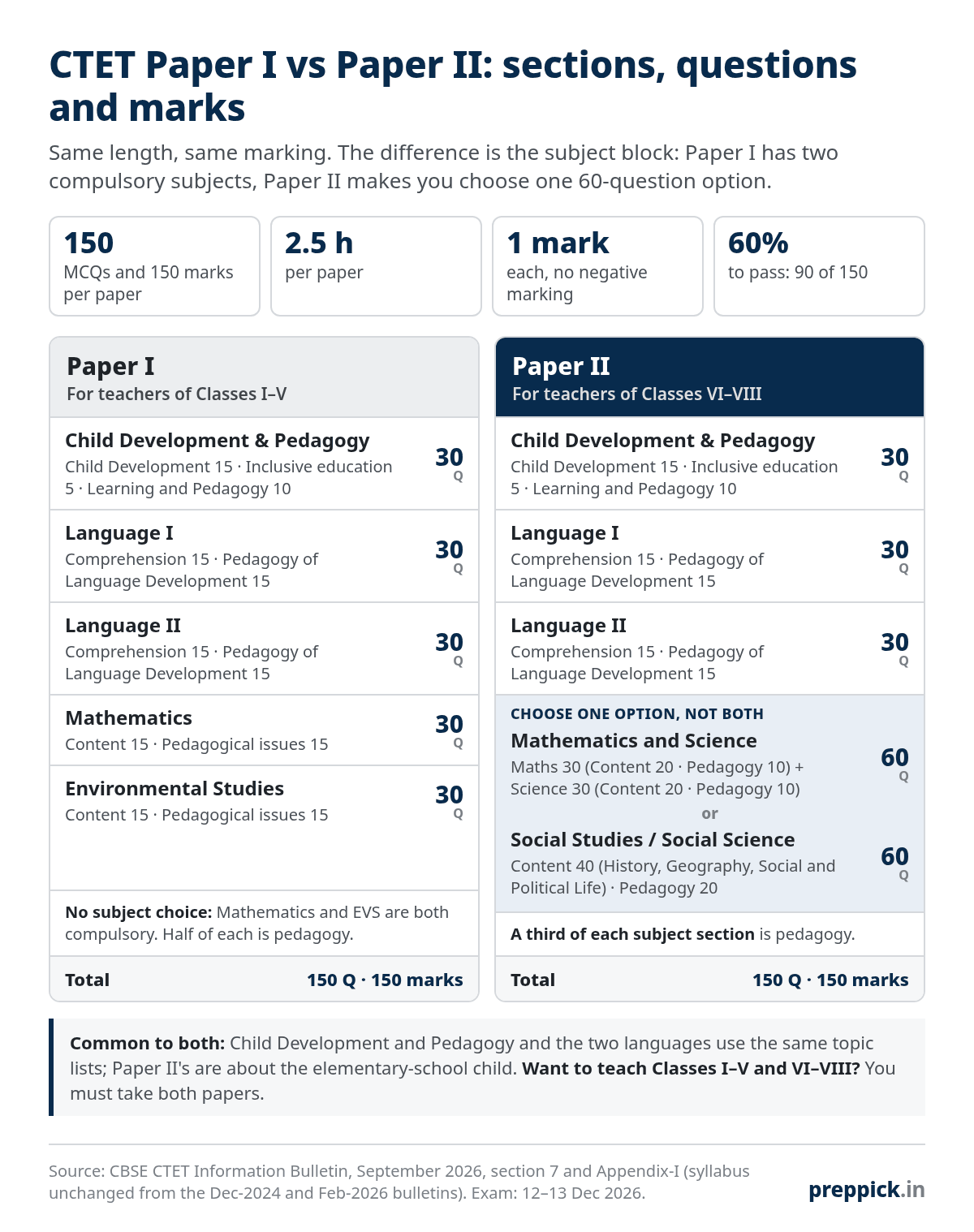
CTET exam pattern at a glance
| Paper | Sections (questions) | Questions | Marks | Duration | Negative marking |
|---|---|---|---|---|---|
| Paper I (Classes I–V) | Child Development and Pedagogy (30) · Mathematics (30) · Environmental Studies (30) · Language I (30) · Language II (30), all compulsory | 150 MCQs | 150 | Two and a half hours | None |
| Paper II (Classes VI–VIII) | Child Development and Pedagogy (30) · Language I (30) · Language II (30) · either Mathematics and Science (60) or Social Studies/Social Science (60) | 150 MCQs | 150 | Two and a half hours | None |
Every question is a multiple-choice question with four options and carries one mark. The main question paper is bilingual, Hindi and English; Language I and II are in the languages you choose. Pass mark: 60%, or 90 out of 150. Source: CTET Information Bulletin, September 2026, sections 7–9 (re-checked 26 Oct 2026).
Quick verdict: books for this syllabus
- If you buy only one book: Arihant Success Master CTET 2026 for your paper and medium. It covers every section of the syllabus below in one book: notes, MCQs and solved papers. Paper 1 English ₹392 · Paper 1 Hindi ₹421 · Paper 2 Maths & Science English ₹416 · Paper 2 Social Science English ₹392 (all Amazon).
- Budget pick under ₹500: Success Master itself is under ₹500 in every version above. For a thinner revision book, Arihant’s CTET Kit 2026 Paper 1 is ₹313 in Hindi and ₹326 in English.
- Free first: CBSE’s past papers on ctet.nic.in/archive, and the NCERT Class I–VIII textbooks that the bulletin itself points to for the detailed syllabus.
- Edition check: buy the 2026 edition for your exact paper, subject option and medium; the six Success Master versions look alike. Match the ISBN on the listing with the copyright page.
Prices checked 26 Oct 2026; they change daily. Full comparison: our CTET books guide.
CTET syllabus at a glance
| Paper I | Paper II | |
|---|---|---|
| For teachers of | Classes I to V | Classes VI to VIII |
| Sections | Child Development and Pedagogy, Language I, Language II, Mathematics, Environmental Studies (30 MCQs each) | Child Development and Pedagogy (30), Language I (30), Language II (30), plus either Mathematics and Science (60) or Social Studies/Social Science (60) |
| Total | 150 MCQs, 150 marks | 150 MCQs, 150 marks |
| Duration | Two and a half hours | Two and a half hours |
Source: CTET Sept-2026 Information Bulletin, section 7 (“Structure and Content of CTET”) and Appendix-I (“Structure and Content of Syllabus”). Checked 20 Oct 2026.
All questions are multiple choice with four options, one mark each, and no negative marking.
How to find the syllabus in the official bulletin
- Open ctet.nic.in.
- On the home page, open the Public Notices tab.
- Click CTET SEPT 2026 INFORMATION BULLETIN. It opens as a PDF of about 1 MB.
- Go to section 7, “Structure and Content of CTET” (PDF page 9) for the papers, sections and marks.
- Go to Appendix-I, “Structure and Content of Syllabus” (PDF pages 14–20) for the topic lists. The page ends by pointing you to the NCERT syllabus and textbooks for Classes I–VIII.
Which paper should you take?
- Paper I if you want to teach Classes I to V.
- Paper II if you want to teach Classes VI to VIII.
- Both papers if you want to teach at both levels. The bulletin says such a candidate “will have to appear in both the papers”.
CTET Paper I syllabus (Classes I–V)
| Section | How the 30 questions split |
|---|---|
| Child Development and Pedagogy | Child Development 15 · Inclusive education 5 · Learning and Pedagogy 10 |
| Language I | Language Comprehension 15 · Pedagogy of Language Development 15 |
| Language II | Comprehension 15 · Pedagogy of Language Development 15 |
| Mathematics | Content 15 · Pedagogical issues 15 |
| Environmental Studies | Content 15 · Pedagogical issues 15 |
Half of the Mathematics and EVS questions test how to teach the subject, not just the subject itself.
Child Development and Pedagogy (30 questions)
a) Child Development, primary school child (15)
- ☐ Concept of development and its relationship with learning; principles of the development of children
- ☐ Influence of heredity and environment
- ☐ Socialisation processes: social world and children (teacher, parents, peers)
- ☐ Piaget, Kohlberg and Vygotsky: constructs and critical perspectives
- ☐ Concepts of child-centred and progressive education
- ☐ Critical perspective of the construct of intelligence; multi-dimensional intelligence
- ☐ Language and thought
- ☐ Gender as a social construct; gender roles, gender bias and educational practice
- ☐ Individual differences among learners (language, caste, gender, community, religion etc.)
- ☐ Assessment for learning vs assessment of learning; school-based assessment; CCE: perspective and practice
- ☐ Framing questions to assess readiness, enhance learning and critical thinking, and assess achievement
b) Inclusive education and children with special needs (5)
- ☐ Learners from diverse backgrounds, including disadvantaged and deprived
- ☐ Children with learning difficulties, “impairment” etc.
- ☐ The bulletin’s wording: “Addressing the Talented, Creative, Specially baled [sic] Learners”
c) Learning and Pedagogy (10)
- ☐ How children think and learn; how and why children “fail” to achieve success in school performance
- ☐ Basic processes of teaching and learning; children’s strategies of learning; learning as a social activity; social context of learning
- ☐ Child as a problem solver and a “scientific investigator”
- ☐ Alternative conceptions of learning; children’s “errors” as significant steps in learning
- ☐ Cognition and emotions; motivation and learning
- ☐ Factors contributing to learning: personal and environmental
Mathematics (30 questions)
| Part | Topics |
|---|---|
| Content (15) | Geometry · Shapes and spatial understanding · Solids around us · Numbers · Addition and subtraction · Multiplication · Division · Measurement · Weight · Time · Volume · Data handling · Patterns · Money |
| Pedagogical issues (15) | Nature of mathematics/logical thinking, and children’s thinking, reasoning and meaning-making · Place of mathematics in the curriculum · Language of mathematics · Community mathematics · Formal and informal evaluation · Problems of teaching · Error analysis · Diagnostic and remedial teaching |
Environmental Studies (30 questions)
| Part | Topics |
|---|---|
| Content (15) | Family and friends (relationships; work and play; animals; plants) · Food · Shelter · Water · Travel · Things we make and do |
| Pedagogical issues (15) | Concept and scope of EVS · Significance of EVS, integrated EVS · Environmental studies and environmental education · Learning principles · Scope and relation to science and social science · Approaches to presenting concepts · Activities · Experimentation/practical work · Discussion · CCE · Teaching material/aids · Problems |
Language I and Language II (30 questions each)
| Part | Language I | Language II |
|---|---|---|
| Comprehension (15) | Two unseen passages, one prose or drama and one poem, with questions on comprehension, inference, grammar and verbal ability. The prose may be literary, scientific, narrative or discursive | Two unseen prose passages (discursive, literary, narrative or scientific), with questions on comprehension, grammar and verbal ability |
| Pedagogy of Language Development (15) | Same list for both languages (below) | Same list for both languages (below) |
Pedagogy of Language Development:
- ☐ Learning and acquisition; principles of language teaching
- ☐ Role of listening and speaking; function of language and how children use it as a tool
- ☐ Critical perspective on the role of grammar in learning a language for communicating ideas, verbally and in writing
- ☐ Challenges of teaching language in a diverse classroom; language difficulties, errors and disorders
- ☐ Language skills
- ☐ Evaluating language comprehension and proficiency: speaking, listening, reading and writing
- ☐ Teaching-learning materials: textbook, multimedia materials, the classroom’s multilingual resources
- ☐ Remedial teaching
CTET Paper II syllabus (Classes VI–VIII)
| Section | Questions | Split |
|---|---|---|
| Child Development and Pedagogy | 30 | Child Development 15 · Inclusive education 5 · Learning and Pedagogy 10 |
| Language I | 30 | Language Comprehension 15 · Pedagogy of Language Development 15 |
| Language II | 30 | Comprehension 15 · Pedagogy of Language Development 15 |
| Option 1: Mathematics and Science | 60 | Mathematics 30 (Content 20 · Pedagogical issues 10) + Science 30 (Content 20 · Pedagogical issues 10) |
| Option 2: Social Studies/Social Science | 60 | Content 40 · Pedagogical issues 20 |
You take one of the two options, not both.
Child Development and Pedagogy, and the two languages
The topic lists are the same as in Paper I, except that Child Development is about the elementary school child. Two items read differently in the bulletin:
- “Addressing the Talented, Creative, Specially abled Learners” is spelt correctly in Paper II.
- The Learning and Pedagogy item reads “Child as a problem solve rand a “scientific investigator” [sic]”.
Mathematics and Science option (60 questions)
| Subject | Part | Topics |
|---|---|---|
| Mathematics | Content (20) | Number system: knowing our numbers, playing with numbers, whole numbers, negative numbers and integers, fractions · Algebra: introduction to algebra, ratio and proportion · Geometry: basic geometrical ideas (2-D), understanding elementary shapes (2-D and 3-D), symmetry (reflection), construction (using straight edge, scale, protractor, compasses) · Mensuration · Data handling |
| Pedagogical issues (10) | Nature of mathematics/logical thinking · Place of mathematics in the curriculum · Language of mathematics · Community mathematics · Evaluation · Remedial teaching · Problem of teaching | |
| Science | Content (20) | Food: sources, components, cleaning food · Materials of daily use · The world of the living · Moving things, people and ideas · How things work: electric current and circuits, magnets · Natural phenomena · Natural resources |
| Pedagogical issues (10) | Nature and structure of sciences · Natural science: aims and objectives · Understanding and appreciating science · Approaches/integrated approach · Observation, experiment, discovery (method of science) · Innovation · Text material/aids · Evaluation: cognitive, psychomotor, affective · Problems · Remedial teaching |
Social Studies/Social Science option (60 questions)
| Part | Topics |
|---|---|
| History (content) | When, where and how · The earliest societies · The first farmers and herders · The first cities · Early states · New ideas · The first empire · Contacts with distant lands · Political developments · Culture and science · New kings and kingdoms · Sultans of Delhi · Architecture · Creation of an empire · Social change · Regional cultures · The establishment of Company power · Rural life and society · Colonialism and tribal societies · The Revolt of 1857–58 · Women and reform · Challenging the caste system · The nationalist movement · India after independence |
| Geography (content) | Geography as a social study and as a science · Planet: Earth in the solar system · Globe · Environment in its totality: natural and human environment · Air · Water · Human environment: settlement, transport and communication · Resources: natural and human · Agriculture |
| Social and Political Life (content) | Diversity · Government · Local government · Making a living · Democracy · State government · Understanding media · Unpacking gender · The Constitution · Parliamentary government · The judiciary · Social justice and the marginalised |
| Pedagogical issues (20) | Concept and nature of social science/social studies · Classroom processes, activities and discourse · Developing critical thinking · Enquiry/empirical evidence · Problems of teaching social science · Sources: primary and secondary · Project work · Evaluation |
History, Geography and Social and Political Life together make up the 40 content questions; the bulletin gives no split between them.
For the detailed syllabus of Classes I–VIII, the bulletin refers candidates to the NCERT syllabus and textbooks (end of Appendix-I).
Paper I vs Paper II: what’s common and what differs
| Paper I | Paper II | |
|---|---|---|
| Child Development and Pedagogy | 30 questions | 30 questions |
| Languages | Language I + Language II, 30 each | Language I + Language II, 30 each |
| Subject choice | None: Mathematics and EVS are both compulsory | Choose Mathematics and Science or Social Studies |
| Pedagogy share in subjects | Half of Mathematics and EVS | A third of each subject section |
| CDP and language topics | Primary school child | Same lists, for the elementary school child |
Languages and language codes: 27 now offered
The Sept-2026 bulletin lists 27 languages, up from 20 in the Dec-2024 and Feb-2026 bulletins. The seven additions are Bodo, Dogri, Kashmiri, Konkani, Maithili, Santhali and Sindhi (codes 21–27).
| Language | Code | Language | Code | Language | Code |
|---|---|---|---|---|---|
| English | 01 | Malayalam | 09 | Telugu | 18 |
| Hindi | 02 | Manipuri | 10 | Tibetan | 19 |
| Assamese | 03 | Marathi | 11 | Urdu | 20 |
| Bengali | 04 | Mizo | 12 | Bodo | 21 |
| Garo | 05 | Nepali | 13 | Dogri | 22 |
| Gujarati | 06 | Odia | 14 | Kashmiri | 23 |
| Kannada | 07 | Punjabi | 15 | Konkani | 24 |
| Khasi | 08 | Sanskrit | 16 | Maithili | 25 |
| Tamil | 17 | Santhali | 26 | ||
| Sindhi | 27 |
Source: CTET Information Bulletin, September 2026, section 7 and the form-filling appendix (item 2), transcribed by us on 26 Oct 2026.
- Language I tests the language you will teach in (the bulletin calls it “the medium of instruction”); Language II tests communication and comprehension in a second language.
- Language II must be different from Language I.
- Answer only in the two languages printed on your admit card. The bulletin says candidature is cancelled if you answer in any other language.
Pass marks and certificate validity
- Pass mark: “A person who scores 60% or more in the TET exam will be considered as TET pass” (section 9, citing the NCTE notification of 11.02.2011). On a 150-mark paper that works out to 90 marks.
- Concessions: CBSE sets no lower pass mark by category. The bulletin says school managements “may consider giving concessions” to SC/ST, OBC, differently abled and other candidates under their reservation policy.
- Validity: the CTET certificate is valid “for life time for all categories”, and there is no limit on attempts (section 11).
December 2026 exam: what’s confirmed
| Item | Status |
|---|---|
| Exam dates | 12 and 13 December 2026 (CBSE notice, 14.09.2026) |
| City and date for each candidate | On the CTET portal 15 days before the exam |
| Admit card | On the CTET portal two days before the exam |
| Shift timings | Not announced for December as of 26 Oct 2026. The September bulletin’s timings were for the original 6 September date, so go by your admit card and CBSE’s CTET notices. |
| Result date | Not announced for the December exam as of 26 Oct 2026 |
Free official resources
- CTET Information Bulletin, September 2026: section 7 for the pattern, Appendix-I for the syllabus.
- CBSE notice: exam dates for the 22nd CTET (14.09.2026).
- CTET public notices page. Use this page, not the “Information Bulletin” page. The bulletin page still shows Feb-2026 as its newest entry.
Practise with past papers
CBSE publishes old CTET question papers free on ctet.nic.in/archive, under “Previous Year Question Paper”. The list runs from December 2018 to February 2026. The February 2026 page has separate zip files for each paper, exam date and question-paper set.
- Solve at least one full Paper I or Paper II set in two and a half hours, with no breaks, before the exam.
- Mark which questions were pedagogy and which were content. That shows you which half of each section needs work.
- The syllabus hasn’t changed since these papers were set (see the FAQ below), so they are fair practice for December 2026.
If you’d rather work from a printed solved-papers book, see which PYQ book, if any, is worth buying in our CTET books guide.
CTET सिलेबस: हिंदी में सारांश
22वाँ CTET 12 और 13 दिसंबर 2026 को होगा। पहले यह 6 सितंबर 2026 को होना था। सिलेबस वही है जो दिसंबर 2024 और फ़रवरी 2026 के बुलेटिन में था।
| पेपर I | पेपर II | |
|---|---|---|
| किसके लिए | कक्षा 1 से 5 के शिक्षक | कक्षा 6 से 8 के शिक्षक |
| खंड | बाल विकास और शिक्षाशास्त्र, भाषा I, भाषा II, गणित, पर्यावरण अध्ययन (हर खंड में 30 प्रश्न) | बाल विकास और शिक्षाशास्त्र, भाषा I, भाषा II (हर खंड में 30 प्रश्न), और गणित-विज्ञान या सामाजिक अध्ययन (60 प्रश्न) |
| कुल | 150 प्रश्न, 150 अंक | 150 प्रश्न, 150 अंक |
| समय | ढाई घंटे | ढाई घंटे |
- हर प्रश्न एक अंक का है। गलत उत्तर पर कोई अंक नहीं कटता।
- पास होने के लिए 60% अंक चाहिए, यानी 150 में से 90।
- CTET प्रमाणपत्र जीवन भर मान्य है, और प्रयासों की कोई सीमा नहीं है।
- अब 27 भाषाएँ उपलब्ध हैं।
-
पिछले वर्षों के प्रश्नपत्र ctet.nic.in के Archive पेज पर मुफ़्त हैं (दिसंबर 2018 से फ़रवरी 2026 तक)।
-
बाल विकास और शिक्षाशास्त्र में तीन भाग हैं: बाल विकास (15 प्रश्न), समावेशी शिक्षा और विशेष आवश्यकता वाले बच्चे (5), और अधिगम और शिक्षाशास्त्र (10)।
- गणित, पर्यावरण अध्ययन, विज्ञान और सामाजिक अध्ययन में विषय-वस्तु के साथ शिक्षण से जुड़े प्रश्न (पेडागॉजी) भी आते हैं।
- कक्षा 1 से 8 के विस्तृत सिलेबस के लिए बुलेटिन NCERT के सिलेबस और पाठ्यपुस्तकें देखने को कहता है।
20 अक्टूबर 2026 तक हमें सितंबर 2026 बुलेटिन का अलग हिंदी संस्करण नहीं मिला। यह सारांश हमारा है; आधिकारिक जानकारी के लिए अंग्रेज़ी बुलेटिन देखें।
FAQs
Has the CTET 2026 syllabus changed?
No. We compared Appendix-I of the September 2026 bulletin with the February 2026 bulletin line by line, and the only difference is the bulletin name in the page header. The syllabus is also the same as in the December 2024 bulletin. What did change in September 2026 is the language list, which grew from 20 to 27.
Where can I get CTET previous year papers?
Free from CBSE on ctet.nic.in/archive, from December 2018 to February 2026.
Is 90 marks a pass in CTET?
Yes. The pass mark is 60%, and 60% of 150 is 90. School managements may give concessions to reserved categories; CBSE itself sets no lower mark.
Is CTET valid only for 7 years?
No. The September 2026 bulletin says the certificate is valid for life for all categories.
What is the difference between the CTET Paper 1 and Paper 2 syllabus?
Paper I is for Classes I–V and has compulsory Mathematics and EVS. Paper II is for Classes VI–VIII, where you choose Mathematics and Science or Social Studies. Child Development and Pedagogy and both languages are in both papers.
Can I appear for both Paper 1 and Paper 2?
Yes. To teach both Classes I–V and VI–VIII, you must take both papers.
Is the CTET syllabus available in Hindi?
We could find only the English September 2026 bulletin on CTET’s public notices page, not a separate Hindi version. The Hindi summary above is our own.
Is there negative marking in CTET?
No. Each question carries one mark, and nothing is deducted for a wrong answer.
Is B.Ed compulsory for CTET?
No, and for Paper I a B.Ed alone isn’t enough. CBSE’s bulletin says the minimum qualifications are as notified by NCTE (section 6). For Classes I–V, NCTE’s notification of 23 Aug 2010, as amended, lists Senior Secondary (generally with at least 50% marks) with a 2-year D.El.Ed, a 4-year B.El.Ed or a 2-year Diploma in Education (Special Education), and NCTE’s amendment of 29 Jul 2011 added graduation with a 2-year D.El.Ed. NCTE’s notification No. 462 of 13 Oct 2021 also lists post-graduation (55%) with a 3-year integrated B.Ed.-M.Ed. for Classes I–V, with a 6-month bridge course within two years of appointment, but whether that route still applies after the 2023 Supreme Court judgment is not clear, so confirm it on NCTE’s current notification before relying on it. NCTE added B.Ed for Classes I–V in June 2018, but the Supreme Court quashed that on 11 Aug 2023 (Devesh Sharma v. Union of India). For Paper II (Classes VI–VIII), the 2010 notification as amended on 29 Jul 2011, 13 Nov 2019 and 13 Oct 2021 lists six routes: graduation with a 2-year D.El.Ed; at least 50% marks in graduation or post-graduation with a B.Ed; graduation with at least 45% marks and a 1-year B.Ed, under NCTE’s recognition regulations; Senior Secondary with at least 50% marks and a 4-year B.El.Ed, or a 4-year B.A./B.Sc.Ed or B.A.Ed./B.Sc.Ed; graduation with at least 50% marks and a 1-year B.Ed (Special Education); or post-graduation with at least 55% marks (or an equivalent grade) and a 3-year integrated B.Ed.-M.Ed. So graduation with a B.Ed does qualify for Paper II. The minimum graduation percentage doesn’t apply if you were admitted to your B.Ed before 29 Jul 2011. SC, ST, OBC and differently-abled candidates get up to 5% relaxation in the qualifying marks (bulletin, section 6).
Can I clear CTET in 2 months?
Two months can be enough to cover the syllabus once and practise, if you study daily and stick to one book. A plan built from the section tables above: weeks 1–2, Child Development and Pedagogy (all three parts); weeks 3–4, Language I and II, mostly the pedagogy half; weeks 5–6, Mathematics and EVS for Paper I, or your Paper II option, content and pedagogy together; week 7, three full past papers from ctet.nic.in/archive in two and a half hours each; week 8, revise the sections where you dropped most marks and sit two more papers. Our CTET books guide lists one book per paper so you don’t spread across several.
What are the CTET language codes?
The September 2026 bulletin numbers its 27 languages from 01 (English) and 02 (Hindi) to 27 (Sindhi). The full table is in the languages section above.
Sources (checked 20 Oct 2026; CTET site reopened 26 Oct 2026)
- CBSE: Information Bulletin, CTET-February 2026 (Appendix-I, for the syllabus comparison)
- CBSE: CTET archive: previous year question papers and the February 2026 question papers page
- CBSE: CTET Information Bulletin page
- CBSE: Information Bulletin, CTET-September 2026 (sections 7, 9 and 11; Appendix-I)
- CBSE: Public notice, conduct of the 22nd CTET on 12–13 Dec 2026 (14.09.2026)
- CBSE: Public notice, 22nd CTET (08.05.2026; original date and the 27 languages)
- CBSE: Reopening of applications (25.08.2026)
- CBSE: CTET public notices page (rechecked 26 Oct 2026: no notice after 14.09.2026)
- Supreme Court of India: Devesh Sharma v. Union of India, judgment of 11.08.2023 (quotes NCTE’s 2010 qualifications for Classes I–V)
- NCTE: Gazette notifications on minimum qualifications for Classes I–VIII, as linked from NCTE’s Minimum Qualifications of Teachers page: 23.08.2010, 29.07.2011, 28.06.2018 (quashed in 2023), 13.11.2019 and 13.10.2021, No. 462. The page itself returned 403 from our side on 26 Oct 2026, so we took the links from its 21 Aug 2026 web-archive copy and read the PDFs on NCTE’s file server.
- Amazon product pages for the books in the quick verdict (prices checked 26 Oct 2026)
Updated 26 Oct 2026 (v3): what changed
- Added “CTET exam pattern at a glance” (paper, sections, questions, marks, duration, negative marking) near the top.
- Added the language-code table (01–27) from the bulletin, with the rules on choosing Language I and II.
- Added FAQs on whether B.Ed is compulsory, a 2-month plan and language codes.
- Added a quick verdict with one book per paper, a budget pick, free alternatives and an affiliate disclosure (prices checked 26 Oct 2026).
Earlier update, 26 Oct 2026 (v2):
- Added an “Official CTET syllabus PDF: where it is” box and a five-step guide to finding the syllabus in the bulletin.
- Added a “Practise with past papers” section linking CBSE’s free question-paper archive.
- Added FAQs on whether the 2026 syllabus has changed (we compared the September and February 2026 bulletins) and where to find past papers, plus a “How we checked this page” note.
Related: CTET Paper 2 books · CTET books in Hindi · Super TET books