
The NCERT books for UPSC that matter are about ten Class 11–12 titles: the four Geography books, Themes in Indian History Parts I–III, Indian Constitution at Work, Indian Economic Development and Introductory Macroeconomics. All are free PDFs on NCERT’s site. This guide gives a class-wise and subject-wise reading order, which NCERTs to skip, old versus new NCERTs, and how to make notes that carry you into Laxmikanth, Spectrum and Leong.
Best NCERT Books for UPSC at a Glance
| Subject | NCERT (class) | Why it’s on the list |
|---|---|---|
| Geography | Fundamentals of Physical Geography (XI) | The base of Prelims physical geography; read first |
| Geography | India: Physical Environment (XI) | India’s relief, drainage, climate and monsoon |
| Geography | Fundamentals of Human Geography (XII) | Human geography basics, read selectively |
| Geography | India: People and Economy (XII) | Population, resources and the Indian economic setting |
| History | Themes in Indian History Part I (XII) | Early India by theme |
| History | Themes in Indian History Part II (XII) | Medieval themes: travellers, bhakti-sufi, Vijayanagara |
| History | Themes in Indian History Part III (XII) | The most UPSC-relevant History volume; leads into Spectrum |
| Polity | Indian Constitution at Work (XI) | The easiest way into the Constitution before Laxmikanth |
| Economy | Indian Economic Development (XI) | Planning, reforms and sectors of the Indian economy |
| Economy | Introductory Macroeconomics (XII) | GDP, money, banking and the budget, before Ramesh Singh |
| All subjects | Free PDFs on ncert.nic.in | Every book here, in English and Hindi |
By PrepPick Editorial Team · Last updated 3 November 2026
Editions checked on 26 Oct 2026. Prices checked on 26 Oct 2026.
How we checked this page: titles and codes from NCERT’s current rate list; free links from NCERT’s textbook page; roll-out dates from NCERT’s advisory; GS paper headings from UPSC’s CSE 2026 notice; reading advice compared with the leading UPSC NCERT lists under Sources. Our methodology · About PrepPick
How many NCERTs you actually need
Most ranking lists give you every NCERT from Class 6 to 12; BYJU’S says “ideally” you’d work through all of them. You don’t have to. The ten books above cover what UPSC draws from NCERTs, and with CSE 2027 Prelims listed for 23 May 2027 (tentative) in UPSC’s calendar, time spent on forty school books is time not spent on revision. Junior books are a back-up: open one only when a Class 11–12 chapter assumes something you don’t know.
NCERTs still matter. Vajiram & Ravi’s NCERT page says that in the 2024 Prelims “more than 5 questions were directly sourced from NCERT books”. They are the base, not the whole syllabus: after each subject you move to the standard book in our UPSC booklist.
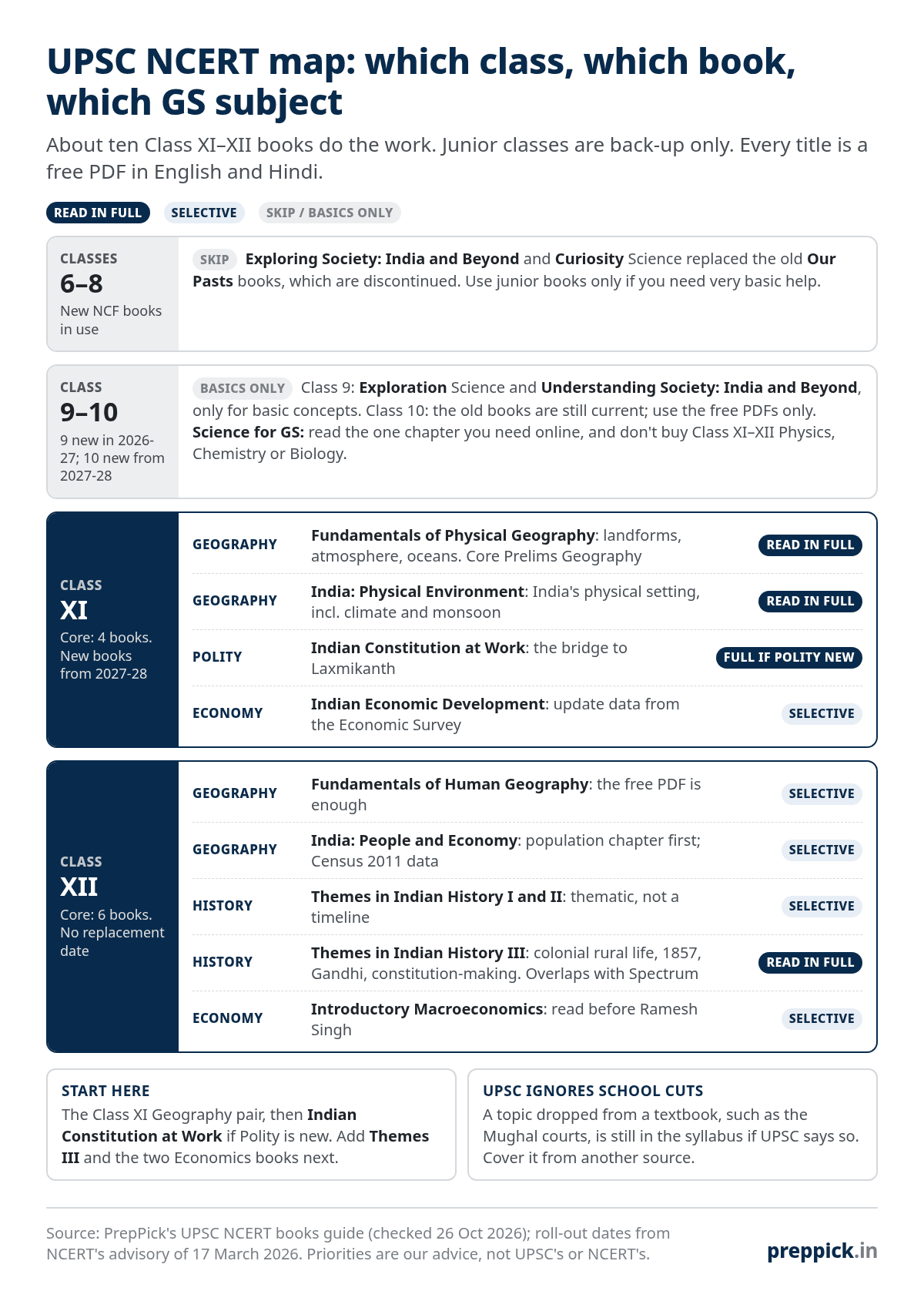
Reading order: class-wise and subject-wise
Class-wise rule: Class 11 before Class 12 in each subject; Class 6–10 only to fill a gap. Mentor replies on BYJU’S NCERT page are close: for History, start directly from Class 11; for Geography, they suggest skimming the junior books first, which we’d keep for real gaps only.
Subject order: Geography and Polity first (they are the most concept-heavy and help everything else), then Modern History, Economy, Ancient and Medieval History, and the GS I extras.
| Order | Subject | Read in this order | Then move to |
|---|---|---|---|
| 1 | Geography | Fundamentals of Physical Geography → India: Physical Environment → Fundamentals of Human Geography → India: People and Economy, with an atlas open | G. C. Leong’s physical half (our Leong guide, UPSC geography books) |
| 2 | Polity | Indian Constitution at Work → Politics in India since Independence (for Mains) | Laxmikanth (our Laxmikanth guide) |
| 3 | Modern History | Themes III | Spectrum (our Spectrum guide) |
| 4 | Economy | Class 10 Understanding Economic Development (if economics is new) → Indian Economic Development → Introductory Macroeconomics | Ramesh Singh or another standard book, plus the Economic Survey |
| 5 | Ancient & Medieval | Themes I → Themes II | An old NCERT or standard book (UPSC history books) |
| 6 | Art & Culture | An Introduction to Indian Art Part I | A culture book only if PYQs show the need |
| 7 | Society, IR, Environment | Indian Society; Contemporary World Politics; Class 12 Biology ecology chapters | Mains notes and current affairs |
Solve UPSC’s previous Prelims questions for a subject as soon as you finish its NCERTs, before you open the standard book.
What to read in each book
Chapter numbering changed after the 2022-23 cuts, so we describe what each book is used for rather than list chapter numbers. Check the contents page of the current PDF before you plan.
| Book | What UPSC uses it for | Priority | Note |
|---|---|---|---|
| Fundamentals of Physical Geography | Landforms, atmosphere and oceans | Read in full | Core Prelims Geography |
| India: Physical Environment | India’s physical setting, including the climate and monsoon chapter | Read in full | Buyers say it is thin (about 72 pages). That is the 2022-23 cuts, not a printing fault |
| Fundamentals of Human Geography | Nature and scope of human geography; people and environment | Selective | Free PDF is enough |
| India: People and Economy | Population and the Indian economic setting | Selective (population chapter first) | Uses Census 2011 data, so check figures before quoting them |
| Themes I | Selected early-India themes | Selective | Thematic, not a timeline |
| Themes II | Travellers, devotional traditions, Vijayanagara, agrarian society | Selective | The Mughal-courts theme (“Kings and Chronicles”) was removed in 2022-23 |
| Themes III | Colonial rural life, the 1857 revolt, Gandhi, constitution-making | Read in full | Overlaps with Spectrum |
| Indian Constitution at Work | Introduction to the Constitution and its institutions | Read in full if Polity is new | Bridge to Laxmikanth |
| Indian Economic Development | Issues and choices in the Indian economy | Selective | Update data from the Economic Survey |
| Introductory Macroeconomics | Economy-wide concepts | Selective | Read before Ramesh Singh |
| Class 12 Biology (free PDF) | Environment and ecology | Only the ecology chapters at the end (organisms and populations, ecosystem, biodiversity and conservation) | Older lists cite “chapters 13 to 16”, which is pre-2022 numbering; the current book has 13 chapters |
Which NCERTs to skip
- The old Class 6–8 Our Pasts, The Earth Our Habitat and Social and Political Life books. Most ranking lists (Vajiram & Ravi, BYJU’S, Anuj Jindal) still list them, but NCERT has replaced them with Exploring Society: India and Beyond. Don’t hunt for discontinued copies.
- The new Class 6–9 books, unless your basics are weak. They are thematic and simpler; skim, don’t take notes.
- Class 11–12 Physics, Chemistry and most of Biology. For GS, use school-level science chapters for a forgotten concept and the Class 12 ecology chapters for Environment.
- Statistics for Economics and Introductory Microeconomics, unless economics is your optional or a concept still won’t click.
- Psychology (Class 11–12) for GS IV. Vajiram & Ravi and BYJU’S list it; BYJU’S itself calls it “not too significant from the exam perspective”. Read it only if you have time after the core ten.
- NCERT “summary” books for a first read. They help with revision once you understand a topic.
Class 6–12 NCERTs mapped to GS papers
The full list of NCERT books worth knowing about for UPSC, by class. Titles and codes are as printed on NCERT’s current rate list; the free links are NCERT’s own textbook pages, taken from the book menu on ncert.nic.in/textbook.php on 26 Oct 2026. The GS paper column uses the paper headings in the UPSC CSE 2026 notice:
- GS I: Indian Heritage and Culture, History and Geography of the World and Society
- GS II: Governance, Constitution, Polity, Social Justice and International relations
- GS III: Technology, Economic Development, Bio diversity, Environment, Security and Disaster Management
- GS IV: Ethics, Integrity and Aptitude
“Read” and “Skim” are our suggestion for a first-time UPSC aspirant, not an official label. The ten rows marked core ten are the books worth owning in print; everything else is fine as a free PDF.
| GS paper | Subject | Class | NCERT title (code) | Free on ncert.nic.in | For UPSC |
|---|---|---|---|---|---|
| GS I, II, III | Social Science | 6 | Exploring Society: India and Beyond (681) | Skim | |
| GS III | Science | 6 | Curiosity (677) | Skim (only if science is weak) | |
| GS I, II, III | Social Science | 7 | Exploring Society: India and Beyond Part 1 (781) | Skim | |
| GS I, II, III | Social Science | 7 | Exploring Society: India and Beyond Part 2 (782) | Skim | |
| GS III | Science | 7 | Curiosity (777) | Skim (only if science is weak) | |
| GS I, II, III | Social Science | 8 | Exploring Society: India and Beyond Part 1 (881) | Skim | |
| GS I, II, III | Social Science | 8 | Exploring Society: India and Beyond Part-II (882) | Skim | |
| GS III | Science | 8 | Curiosity (877) | Skim (only if science is weak) | |
| GS I, II, III | Social Science | 9 | Understanding Society: India and Beyond Part-1 (908) | Skim | |
| GS I, II, III | Social Science | 9 | Understanding Society: India and Beyond Part-II (no code on the rate list yet) | Skim | |
| GS III | Science | 9 | Exploration (906) | Skim (only if science is weak) | |
| GS I (modern world history) | History | 10 | India and the Contemporary World II (1066) | Skim | |
| GS I (geography) | Geography | 10 | Contemporary India II (1068) | Skim | |
| GS II (polity) | Political Science | 10 | Democratic Politics II (1072) | Skim | |
| GS III (economy) | Economics | 10 | Understanding Economic Development (1070) | Read | |
| GS III (science and technology) | Science | 10 | Science (1064) | Skim (only if science is weak) | |
| GS I (world history) | History | 11 | Themes in World History (11090) | Skim | |
| GS I (geography) | Geography | 11 | Fundamentals of Physical Geography (11092) | Read (core ten) | |
| GS I (geography) | Geography | 11 | India: Physical Environment (11094) | Read (core ten) | |
| GS II (polity) | Political Science | 11 | Indian Constitution at Work (11102) | Read (core ten) | |
| GS II, GS IV | Political Science | 11 | Political Theory (11117) | Skim | |
| GS III (economy) | Economics | 11 | Indian Economic Development (11100) | Read (core ten) | |
| GS III (economy) | Economics | 11 | Statistics for Economics (11098) | Skim (optional) | |
| GS I (society) | Sociology | 11 | Introducing Sociology (11104) | Skim | |
| GS I (society) | Sociology | 11 | Understanding Society (11106) | Skim | |
| GS I (art and culture) | Fine Art | 11 | An Introduction to Indian Art Part I (11144) | Read | |
| GS I (art and culture) | Knowledge Traditions and Practices of India | 11 | Knowledge Traditions and Practices of India Part I (11151) | Skim | |
| GS III (environment) | Biology | 11 | Biology (11080) | Skim (only the chapters you need) | |
| GS I (history and culture) | History | 12 | Themes in Indian History Part I (12093) | Read (core ten) | |
| GS I (history and culture) | History | 12 | Themes in Indian History Part II (12094) | Read (core ten) | |
| GS I (modern history) | History | 12 | Themes in Indian History Part III (12125) | Read (core ten) | |
| GS I (geography) | Geography | 12 | Fundamentals of Human Geography (12097) | Read (core ten) | |
| GS I (geography) | Geography | 12 | India: People and Economy (12099) | Read (core ten) | |
| GS III (economy) | Economics | 12 | Introductory Macroeconomics (12105) | Read (core ten) | |
| GS III (economy) | Economics | 12 | Introductory Microeconomics (12103) | Skim (optional) | |
| GS I (society) | Sociology | 12 | Indian Society (12111) | Read | |
| GS I (society) | Sociology | 12 | Social Change and Development in India (12109) | Skim | |
| GS II (international relations) | Political Science | 12 | Contemporary World Politics (12107) | Read | |
| GS I, GS II (post-independence India) | Political Science | 12 | Politics in India since Independence (12119) | Read | |
| GS I (art and culture) | Fine Art | 12 | An Introduction to Indian Art Part II (12144) | Skim | |
| GS III (environment, biotechnology) | Biology | 12 | Biology (12083) | Skim (only the chapters you need) |
- Class 6–9 are the new NCF-SE 2023 books. Skim them only if a senior book feels too hard.
- Class 10 and 11 change from 2027-28 (see old vs new NCERTs). The links point to the books current in 2026-27.
- Class 12 economics titles: NCERT’s textbook page calls them Introductory Macroeconomics and Introductory Microeconomics; the rate list prints “Introducing”. The codes (12105, 12103) are the same book.
The NCERT switch-over: old vs new NCERTs
“Old” means two different things in UPSC talk, and they need different answers.
1. The “old NCERTs” (R. S. Sharma, Satish Chandra, Bipan Chandra). These pre-2000s history textbooks are still on many lists for their narrative. Vajiram & Ravi notes that parts of them are no longer relevant to the current syllabus. They are out of print as NCERTs, so treat any “new” copy sold as one with caution. BYJU’S points to the published versions instead, such as R. S. Sharma’s India’s Ancient Past. Use one if Themes I–II feel too thin, not on top of everything else.
2. The new school textbooks under NCF-SE 2023. NCERT is replacing its books one class at a time:
| Class | Status for 2026-27 | What it means for you |
|---|---|---|
| 6–8 | New books in use: Exploring Society: India and Beyond and Curiosity (Science) | The old Our Pasts and other Class 6–8 social science books are discontinued. Skip junior books unless you need very basic help |
| 9 | New in 2026-27: Exploration (Science; Hindi Anveshan) and Understanding Society: India and Beyond Part 1. NCERT announced Part 2 for sale from late September 2026 (NCERT on X, NCERT on LinkedIn); its free PDF is on NCERT’s textbook page (Part-II) | Use the new books only for basic concepts |
| 10 | Old books still current. New books from 2027-28 (NCERT advisory) | Free PDFs only for UPSC purposes |
| 11 | Old (rationalised) books current. New books from 2027-28 (NCERT advisory) | Download the current Class XI PDFs now. Buying the current print is fine |
| 12 | Old (rationalised) books current. No replacement date announced | No action needed |
NCERT’s advisory of 17 March 2026 says: “The new textbooks for Grades 10 and 11 will be introduced from the academic session 2027-28 onwards. Accordingly, the existing textbooks for Grades 10 and 11 across subject areas shall continue to be used during the academic session 2026-27.” NCERT gives the session, not a release date for each book.
- UPSC does not follow school revisions. A topic dropped from a textbook is still in the UPSC syllabus if the syllabus says so. Cover dropped topics, such as the Mughal courts, from another source.
- Old PDFs may disappear. When the new Class 6–8 books arrived, old versions became harder to find. The same may happen for Class XI (our inference, not an NCERT announcement), so save the PDFs you rely on.
- Pre-2022 prints have chapters that were later removed, so they don’t match current books or PDFs. They are not wrong, just different.
How to read and make notes from NCERTs
- First read, no notes. Read a chapter end to end with a pencil. Mark only the lines you would struggle to explain to someone else.
- Second read, short notes. Write notes in your own words, by syllabus topic, not by chapter. One page per topic is enough. Keep maps and diagrams as sketches, not copied paragraphs.
- Link to PYQs. After each book, open UPSC’s previous papers for that subject and tick the questions the NCERT helps with. Put the question year next to the matching line in your notes.
- Move to the standard book. Add to the same notes from Laxmikanth, Spectrum or Ramesh Singh. Don’t start a second set.
- Revise from your notes, not the NCERT. Go back to the book only for a chapter behind a wrong answer.
Keep notes on paper or in one digital file per GS paper, so revision stays in one place. Link each concept to a current news item as you go; Vajiram & Ravi and Anuj Jindal both make this point, and it is what turns NCERT facts into Mains material.
If you keep losing marks in…
| Losing marks in | Go back to | Then |
|---|---|---|
| Landforms, climate, oceans | Fundamentals of Physical Geography | Leong’s physical half |
| Indian rivers, soils, monsoon | India: Physical Environment, with an atlas | Map practice from places in the news |
| Constitution basics | Indian Constitution at Work | The matching Laxmikanth chapter |
| Modern History | Themes III | Spectrum and its PYQs |
| Ancient and Medieval History | Themes I–II | One old NCERT or standard book |
| Art and Culture | An Introduction to Indian Art Part I | A culture book only if PYQs show a pattern |
| Economy concepts | Indian Economic Development, Introductory Macroeconomics | A standard economy book and the Economic Survey |
| Environment and ecology | Class 12 Biology ecology chapters | Current affairs on species, parks and conventions |
| Society (Mains GS I) | Indian Society | Answer-writing practice |
| CSAT | Not an NCERT problem | Timed official papers; see our UPSC CSAT books guide |
Reading order by stage
| Stage | Read | Optional | Skip |
|---|---|---|---|
| Beginner | Fundamentals of Physical Geography, India: Physical Environment, Indian Constitution at Work (if Polity is new) | Themes III, both Economics books, Class XII Geography | Full Class 6–12 sets; Class XI–XII Science |
| Working aspirant | One subject’s NCERTs at a time, with its PYQs at the weekend | Junior books only where needed | Reading every class “for completeness” |
| Revision / Prelims practice | Your annotated Class XI Geography | Specific chapters after a wrong answer | “NCERT summary” books unless you understand the topic |
| Final phase | Only your own notes and marked pages | Map work with an atlas | Any new NCERT cycle |
| Repeat attempt | Nothing new | The chapters behind last year’s mistakes | Another full read-through |
Hindi-medium students
Every core book has a Hindi edition at the same printed price, and the PDFs are free in Hindi on NCERT’s site. Ask a seller for the Hindi book by its NCERT code, since language versions sometimes get mixed up.
| English | Hindi (code) |
|---|---|
| Fundamentals of Physical Geography | Bhautik Bhugol ke Mool Sidhant (11093) |
| India: Physical Environment | Bharat Bhautik Paryavaran (11095) |
| Fundamentals of Human Geography | Manav Bhugol ke Mul Sidhant (12098) |
| India: People and Economy | Bharat: Log aur Arthavyavastha (12100) |
| Themes in Indian History I–III | Bharatiya Itihas ke Kuchh Vishay Bhag 1–3 (12095, 12096, 12126) |
| Indian Constitution at Work | Bharat ka Samvidhan: Sidhant aur Vyavhar (11103) |
| Indian Economic Development | Bharatiya Arthvyavastha ka Vikas (11101) |
| Introductory Macroeconomics | Samashti Arthashastra: Ek Parichay (12106) |
For the standard books in Hindi (Laxmikanth, Spectrum and others), see our UPSC books in Hindi guide.
Free NCERT PDFs and other free sources
- NCERT textbook PDFs: the official site, every book on this page, chapter-wise or whole, in English and Hindi. Prefer it to third-party “download” pages, which can carry outdated editions.
- List of Rationalised Content in Textbooks for Class XII (NCERT, May 2022): what was removed from each Class XII book. It is listed on NCERT’s rationalised-content page.
- UPSC previous question papers show which NCERT topics actually get asked.
- NCERT’s ePathshala and DIKSHA apps also carry the textbooks (check the edition year in the app before you rely on it).
- If an ncert.nic.in link is slow or won’t open, try again later or use the apps above.
Buying print: genuine copies at a fair price
Buy print only for the books you will annotate and reread, usually the Class XI Geography pair and Indian Constitution at Work; the free PDF is enough for the rest. NCERT prints the price on every copy, and on the current rate list the core ten cost ₹55 to ₹125 each. On 26 Oct 2026 Flipkart sellers were above that printed price on 8 of 9 core books, so compare before you pay, or buy from one of the authorised vendors on ncertbooks.ncert.gov.in.
Photocopied NCERTs: how to spot one
- Inner pages printed in black and white where the genuine book has colour, or grey and blurry text.
- Maps and diagrams that are fuzzy or hard to read.
- No NCERT watermark on the pages and no printed price on the back cover.
- An offer far below the printed price. It may be clearance stock, but check the copy when it arrives.
- Return the copy if it fails these checks.
What buyers say. Buyers are very positive about the content. They call the Geography books basic but essential, describe Indian Constitution at Work as an easy way into the Constitution, and rate the History volumes well. The complaints are almost all about buying: photocopies, sellers charging above the printed price plus shipping, and the “missing chapters” confusion on India: Physical Environment. A few buyers report genuinely torn or missing pages, so check the climate chapter as soon as the book arrives. On forums, the advice is consistent: NCERT first, then the standard book.
Buy the exact books on Amazon
- Fundamentals of Physical Geography (XI)
- India: Physical Environment (XI)
- Fundamentals of Human Geography (XII)
- India: People and Economy (XII)
- Themes in Indian History Part I · Part II · Part III
- Indian Constitution at Work (XI)
- Indian Economic Development (XI)
- Introductory Macroeconomics (XII)
- Hindi editions: search the retailer by the NCERT code in the Hindi table, or buy from an authorised bookseller.
Frequently asked questions
Which NCERT books for UPSC are the most important?
The ten Class 11–12 books in our glance table: four Geography, three Themes in Indian History, Indian Constitution at Work, Indian Economic Development and Introductory Macroeconomics. If you read only one, start with Fundamentals of Physical Geography (Class XI).
Should a beginner start from Class 6?
No. Start with the Class XI Geography pair and Indian Constitution at Work, and open a Class 6–10 book only when a senior chapter assumes basics you lack.
Do I need every NCERT from Class 6 to Class 12?
No. The ten senior books cover most of what UPSC uses, and the old Class 6–8 social science books are discontinued. Our Class 6–12 table marks each book “read” or “skim” and links its free PDF.
Does UPSC ask questions directly from NCERT?
Sometimes. Vajiram & Ravi counts more than five questions in the 2024 Prelims taken directly from NCERT books. Most questions need the standard books and current affairs as well.
Are NCERT books enough for UPSC preparation?
No. They build foundations. You still need standard books such as Laxmikanth and Spectrum, current affairs, practice questions and answer writing. See our UPSC booklist.
Should I read old or new NCERTs?
For Class 11–12, read the current rationalised books, which match the free PDFs. Use an old history NCERT (R. S. Sharma, Satish Chandra) only if Themes I–II feel too thin. New Class XI books arrive from 2027-28, and UPSC doesn’t change its syllabus because a school book changes.
How long does it take to finish NCERTs for UPSC?
It depends on your background. A BYJU’S mentor estimates 2–3 months for the full Class 6–12 set for someone starting from zero; the core ten take much less, so start there and keep the rest for gaps.
Can I use free NCERT PDFs instead of printed books?
Yes. Buy print only for the books you will reread and annotate, usually the Geography pair and Indian Constitution at Work.
Which NCERT is best for history for UPSC?
Themes in Indian History Part III for Modern India, then Parts I and II. Move on to Spectrum for Modern History and our UPSC history books guide for Ancient and Medieval.
Do I need NCERT science books for UPSC?
Not as a purchase. Open the Class 9–10 science chapter for a concept you have forgotten, and read the Class 12 Biology ecology chapters for Environment.
Are Hindi NCERTs the same as the English ones?
Yes: same content, same printed price, different codes. They’re free on NCERT’s site; see the Hindi table above.
Can an NCERT summary replace the original textbook?
Not for a first read. A summary helps with revision once you understand the topic; if it leaves you memorising lines you can’t explain, go back to the original.
Sources
- NCERT: current textbook rate list (generated 16 Jul 2026); authorised-vendor ordering portal; textbook PDFs (book menu read on 26 Oct 2026)
- UPSC: CSE 2026 notification and syllabus (GS paper headings); Calendar 2027; previous question papers
- Class 10–11 roll-out dates: NCERT advisory, F.No.Secy/1-1/2026, 17 March 2026; Class XII removed content: NCERT rationalised-content booklet, May 2022
- UPSC NCERT lists compared on 3 Nov 2026: Vajiram & Ravi, NCERT Books for UPSC (1 Nov 2026); BYJU’S, Complete List of NCERT Books for UPSC; Anuj Jindal, Best Books for UPSC Prelims 2027 and NCERTs (2 Nov 2026); Next IAS, NCERT Books
- Buyer feedback is paraphrased from Amazon.in and Flipkart reviews and UPSC forum discussions read on 19 Oct 2026. Prices were checked on Amazon.in and Flipkart on 26 Oct 2026.
More UPSC guides: Best books for UPSC preparation · Laxmikanth Polity · Spectrum Modern History · G. C. Leong Geography · UPSC history books · UPSC geography books · UPSC CSAT books · UPSC books in Hindi · UPSC books section