
The best books for UPSC preparation in 2027 are fewer than most lists suggest: free NCERTs first, then M. Laxmikanth’s Indian Polity (8th edition) and Spectrum’s A Brief History of Modern India, with G. C. Leong, Ramesh Singh or Agrahari only for a weak area, plus Disha’s topic-wise Prelims PYQs. This guide shows how to use each book paper by paper, the order to read them in, and what to skip.
Best UPSC Books at a Glance
| Need | Pick |
|---|---|
| Polity (buy this first) | M. Laxmikanth, Courseware on Indian Polity, 8th ed. |
| Modern History | Rajiv Ahir, A Brief History of Modern India (Spectrum), 31st ed. |
| Prelims PYQs (GS I + CSAT) | Disha 32 Topic-wise UPSC Prelims PYQs (1995–2026), 17th ed. |
| Maps | Oxford Student Atlas for India, 7th ed. |
| Geography concepts, if NCERT isn’t enough | G. C. Leong, Certificate Physical and Human Geography, OUP 2nd ed. (physical half) |
| Economy, after the NCERTs | Ramesh Singh, Courseware on Indian Economy, 18th ed. |
| Environment, only if it costs you marks | Agrahari, Courseware on Environment, Agriculture & Disaster Management, 4th ed. |
| CSAT, only after a timed test | Bhagat, Concise CSAT, 7th ed. |
| Ethics (Mains GS IV), after Prelims | M. Karthikeyan, Ethics, Integrity and Aptitude, 5th ed. |
| Hindi medium | Bharat Ki Rajvyavastha 8th ed. + Adhunik Bharat Ka Itihas 27th ed. |
| Free, before you pay | NCERT PDFs and UPSC’s own past papers |
By PrepPick Editorial Team · Last updated 3 November 2026
Editions checked on 3 Nov 2026. Prices checked on 26 Oct 2026.
How we checked this page: editions from publisher and Amazon listings; exam rules from UPSC’s CSE 2026 notice and 2027 calendar; study advice compared with the leading UPSC booklists listed under Sources. We don’t score or rate books. Our methodology · About PrepPick
How many books you need, and how to use them
CSE 2027 Prelims is listed for 23 May 2027 (tentative) in UPSC’s 2027 calendar, so you have under seven months. That’s enough to read a short list several times, and not enough to finish a shelf of 25 books. The ranking booklists agree on the rule: Prepp’s guide calls it “one standard book per subject (along with NCERTs)” and notes that top rankers revise the same few books “3–4 rounds minimum”. Before you add any book, write one line: the subject, what you use for it now, and exactly what’s missing.
Use the same routine for every chapter:
- NCERT first. Read the matching NCERT chapter so the standard book makes sense.
- Then the standard book’s chapter (Laxmikanth, Spectrum, Leong and so on). Underline only what you’d want in a last-week revision.
- The same week, solve that topic’s past Prelims questions in Disha’s topic-wise book. They show what UPSC actually asks from the chapter.
- Label every mistake: missing concept, forgotten fact, misread statement or time pressure. Only a missing concept sends you to a new book; the rest need revision or practice.
- Make short notes from your mistakes, not from the whole book. You can’t reread all of Laxmikanth in May; you can reread your notes.
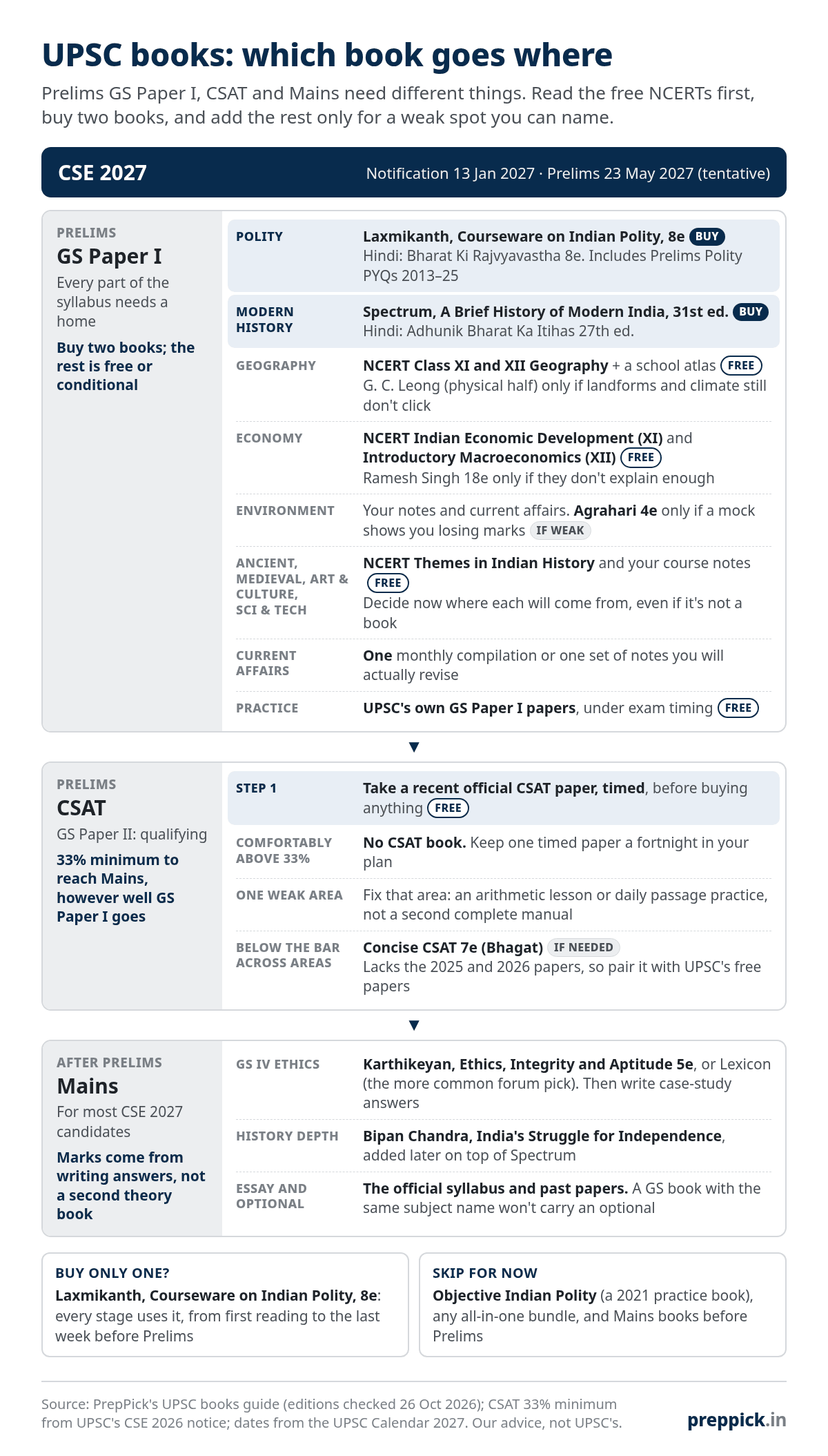
Books by GS paper: which book does which job
| Paper | What it needs | Use | Add only if needed |
|---|---|---|---|
| Prelims GS Paper I | Facts and concepts across Polity, History, Geography, Economy, Environment, S&T, current affairs | NCERTs, Laxmikanth, Spectrum, an atlas, one current-affairs source, Disha topic-wise PYQs | Leong, Ramesh Singh, Agrahari, an Art & Culture book |
| Prelims GS Paper II (CSAT) | Qualifying, 33% minimum: comprehension, reasoning, Class X numeracy | UPSC’s past CSAT papers, timed; the CSAT part of Disha’s PYQ book | Concise CSAT if you’re below the bar across areas |
| Mains GS I | History, culture, geography, society, in written answers | Spectrum, NCERTs, Leong, atlas | Bipan Chandra’s India’s Struggle for Independence, a world history book |
| Mains GS II | Polity, governance, social justice, international relations | Laxmikanth, newspaper editorials | NCERT Politics in India since Independence, Laxmikanth’s Governance in India |
| Mains GS III | Economy, environment, S&T, security, disaster management | Ramesh Singh or NCERT Economy, Economic Survey and Budget, Agrahari | An internal-security book |
| Mains GS IV | Ethics, integrity, aptitude, case studies | Karthikeyan or Lexicon, plus case-study writing | 2nd ARC report on Ethics in Governance (free) |
| Essay and optional | Writing; your optional’s own syllabus | UPSC’s past essay and optional papers | One essay-structure book, if your essays lack shape |
Mains books belong after Prelims for most CSE 2027 candidates. Prepp’s guide makes the same point: the core content overlaps, so the books you read for Prelims also serve Mains, and only Mains-only areas (world history, ethics, post-independence India) need separate books.
Polity: Laxmikanth 8th edition
| Book | Job | Skip if |
|---|---|---|
| NCERT Class XI Indian Constitution at Work (free) | First read | — |
| M. Laxmikanth, Courseware on Indian Polity, 8th ed. (McGraw Hill, July 2025); Hindi Bharat Ki Rajvyavastha | Prelims and Mains GS II reference, with solved Prelims Polity questions 2013–25 | You own the 7th edition (keep it and update recent amendments from free sources) |
How to use it: read NCERT, then one Laxmikanth chapter at a time, and solve the Polity questions in Disha’s PYQ book the same week. On later rounds, use it to look up the provision behind every question you get wrong. It covers the Constitution, Parliament, the executive, courts, federalism and constitutional bodies.
What buyers say. Most buyers call it the standard Polity reference and find the language easy even without a humanities background. A cluster received copies with missing pages, so flip through every page when the parcel arrives. Buyers are split on whether the 8e is a real revision; several feel it is mostly the 7e with newer question papers. No 9th edition has been announced. More in our Laxmikanth Polity guide.
Popular alternatives, honestly: Vajiram & Ravi’s booklist leans on its own “Yellow Books” notes; institute notes can replace your own notes, not Laxmikanth. D. D. Basu’s Introduction to the Constitution of India (on Prepp’s GS II list) is deeper reading for Mains; skip it before Prelims. Objective Indian Polity (2021) is a practice book; the 8e’s solved questions make it unnecessary.
History: Spectrum for Modern India, NCERTs for the rest
| Book | Job | Skip if |
|---|---|---|
| Rajiv Ahir, A Brief History of Modern India (Spectrum, 31st ed. 2025); Hindi Adhunik Bharat Ka Itihas 27th ed. | Modern India for Prelims and revision | — |
| NCERT Themes in Indian History Parts I–III (free) | Ancient, Medieval and some Modern | — |
| Bipan Chandra, India’s Struggle for Independence | Mains depth on the freedom struggle | You’re still before Prelims |
How to use it: Spectrum is point-wise, so it’s built for repeated revision. Read a chapter, solve the Modern History PYQs on it, then revise from your margin notes. Readers like the simple language and start-to-finish coverage; the common complaints are thin paper and a concise format some find dry. Some Amazon listings call themselves the “2026 Edition” without naming one; Spectrum’s own catalogue lists the 31st edition 2025 as current, so check the edition line on the cover. Our Spectrum guide has the details.
Popular alternatives, honestly: Prepp and Vision IAS list the old NCERTs (R. S. Sharma for Ancient, Satish Chandra for Medieval) for a narrative base; use them if Themes feels too thin. Nitin Singhania’s Indian Art and Culture (Prepp, SuperKalam) is the usual Art & Culture book; buy it only if past questions show culture costing you marks. World history books such as Norman Lowe’s are for Mains GS I, after Prelims. Our UPSC history books guide compares them.
Geography: NCERT, an atlas, and Leong’s physical half
| Book | Job | Skip if |
|---|---|---|
| NCERT Class XI Fundamentals of Physical Geography, India: Physical Environment; Class XII Fundamentals of Human Geography, India: People and Economy (free) | Core concepts | — |
| Oxford Student Atlas for India, 7th ed. (OUP, Dec 2025, 160 pages) | Map work for locations, rivers, parks and places in the news | You already own a recent Oxford atlas |
| G. C. Leong, Certificate Physical and Human Geography (OUP India, 2nd ed., Dec 2023) | Landforms, climate and oceans explained simply | NCERT Class XI already makes these clear |
How to use it: read NCERT with the atlas open, and look up every place you meet in the news. Vajiram & Ravi’s booklist stresses map practice for both Prelims and Mains. Read Leong’s physical half (crust, volcanism, landforms, oceans, weather, climatic regions) only if NCERT leaves you confused; aspirants on forums consistently say its human and economic geography is outdated, so use NCERT Class XII for those. Older English atlas editions (4th, 5th, 6th) are still listed as new on Amazon, so check “7th Edition” on the cover. Avoid Leong listings labelled “Latest 2026–27 Edition” from unfamiliar publishers; OUP has no newer edition. See our G. C. Leong guide.
Popular alternatives, honestly: Majid Husain’s geography books (Vision IAS, Vajiram & Ravi) and Savindra Singh’s Physical Geography are deeper books, more useful for Mains or the Geography optional than for Prelims. Our UPSC geography books guide compares them.
Economy: NCERT first, then one book
| Book | Job | Skip if |
|---|---|---|
| NCERT Class XI Indian Economic Development, Class XII Introductory Macroeconomics (free) | Core concepts | — |
| Ramesh Singh, Courseware on Indian Economy, 18th ed. (March 2026) | Thorough reference with online Prelims and Mains questions | You can already connect inflation, monetary policy and the fiscal deficit from the NCERTs |
| Economic Survey and Union Budget (free) | Current figures | — |
How to use it: read the two NCERTs first. Buy Ramesh Singh only if you still can’t connect the big ideas, and read it topic by topic against PYQs rather than cover to cover; forum opinion is clear that beginners often find it dense and stop halfway. Update every figure from the free Economic Survey and Union Budget, never from a printed book.
Popular alternative, honestly: Prepp lists Nitin Singhania’s Indian Economy as the “simplified approach; great for beginners.” Choose Singhania or Ramesh Singh, not both. Uma Kapila (SuperKalam’s Mains pick) is too heavy for a first attempt.
Environment, Science and Tech
| Book | Job | Skip if |
|---|---|---|
| Agrahari, Courseware on Environment, Agriculture & Disaster Management, 4th ed. | One home for Environment, Agriculture and Disaster Management, with Prelims PYQs 2013–25 | A mock doesn’t show you losing marks here |
| NCERT Class 6–10 science and Class XII Biology ecology chapters (free) | S&T and ecology basics | — |
How to use it: cover Environment from NCERT ecology chapters and current affairs first, then take a mock. Buy Agrahari only if Environment questions cost you marks; some readers find it long. Pick one home for agriculture notes, this book or your Economy source.
Popular alternative, honestly: Shankar IAS Academy’s Environment is the book Prepp, SuperKalam and Sleepy Classes name for this slot. It does the same job as Agrahari, so buy one. For Science and Tech, the booklists we compared lean on NCERT science plus current affairs rather than a dedicated book.
CSAT: test yourself before you buy
GS Paper II (CSAT) is qualifying, but the CSE notification fixes its minimum at 33%, and you must clear it to reach Mains however well GS Paper I goes. Take a recent official CSAT paper under timed conditions early, then decide:
- Several timed papers comfortably above 33%: no CSAT book. Keep one timed paper a fortnight in your plan.
- One weak area: fix just that area (a clear arithmetic lesson, or daily passage practice), using the CSAT questions in Disha’s PYQ book.
- Below the bar across areas: an organised book is worth buying. Concise CSAT 7e by Madhukar Kumar Bhagat covers reasoning, numeracy and data interpretation, but it dates from August 2024 and lacks the 2025 and 2026 papers, so pair it with the free official papers. Don’t confuse it with the S. Chand CSAT 8e by Madhukar Kotve.
Popular alternatives, honestly: Vision IAS, Prepp and SuperKalam list R. S. Aggarwal’s Quantitative Aptitude or Verbal & Non-Verbal Reasoning and M. K. Pandey’s Analytical Reasoning. These are general competitive-exam books; use one only for the single area you’re weak in. Our UPSC CSAT books guide compares the options.
Previous-year papers: Disha 32 Topic-wise
UPSC’s past papers are free on its website. A paid book earns its place through sorting and explanations, and Disha’s 32 Topic-wise UPSC Prelims PYQs (1995–2026), 17th edition, by Mrunal Patel is the one we’d buy: Sleepy Classes recommends the series, and it sorts Prelims GS Paper I and CSAT questions by topic so you can practise right after a chapter. Its listing says it holds 3,760 GS and 1,520 CSAT questions with solutions, plus unsolved Mains GS questions (2013–25) and essay topics by theme. It was published on 30 May 2026; the Amazon listing names AIETS.COM PVT. LTD. as publisher.
- Use it topic-wise during reading, and the free official PDFs as full papers for timing practice and deciding which questions to leave.
- A printed key isn’t UPSC’s key. The listing says its solutions are validated against UPSC’s answer key; where an answer still looks doubtful, check UPSC’s official key for that year.
- Buy one PYQ book, not several. Laxmikanth 8e already includes Polity questions from 2013–25.
If you keep losing marks in…
| Losing marks in | Fix it with | Don’t |
|---|---|---|
| Polity statements | Laxmikanth’s chapter for each wrong question; Polity PYQs again | Buy D. D. Basu before Prelims |
| Modern History | Spectrum revision from your notes; Modern History PYQs | Add a second Modern History book before Mains |
| Ancient, Medieval, Art & Culture | NCERT Themes; Singhania only if PYQs show a pattern | Read every culture book on the list |
| Map and location questions | The atlas, daily, with places in the news | Read more Geography theory |
| Physical geography concepts | NCERT Class XI, then Leong’s physical half | Use Leong for human geography |
| Economy concepts | The two NCERTs, then Ramesh Singh or Singhania by topic | Use a printed book for current figures |
| Environment | NCERT ecology + current affairs, then Agrahari or Shankar IAS | Buy both environment books |
| Current affairs | One source you will actually revise | Follow several compilations at once |
| CSAT | Timed official papers; fix the one weak area | Buy a CSAT book before a timed test |
| Misreading statements or running out of time | Timed full papers; mark what you skipped and why | Buy another book: this is practice, not content |
Your study order for CSE 2027
Subject order: NCERTs → Polity (Laxmikanth) and Modern History (Spectrum) → Geography with the atlas → Economy → Environment, S&T, Ancient/Medieval and Art & Culture → current affairs daily throughout. Take one timed CSAT paper in the first month so you know whether it needs time too.
| Stage | Buy | How to use the books | Skip |
|---|---|---|---|
| Beginner (now to Jan 2027) | NCERT PDFs, Laxmikanth, Spectrum, the atlas, Disha’s PYQ book | NCERT → standard book → topic PYQs the same week → mistake notes | Bundles; Mains books |
| Working aspirant | The same short list | Fewer subjects at once: one GS subject plus current affairs on weekdays, PYQs and revision at the weekend | Coaching packs you won’t finish |
| Revision (Feb–Apr 2027) | Nothing new | Second and third rounds from your notes; full official Prelims and CSAT papers, timed | Any new comprehensive book |
| Final phase (May 2027) | Nothing | Your annotated books, mistakes list and free official papers | Starting anything unfamiliar |
| After Prelims | Ethics book; your optional’s books | GS IV case-study writing, Essay practice from past papers, Mains answer writing | Re-reading Prelims books in full |
| Repeat attempt | Only the missing piece that cost you last time | Start from last year’s mistakes list; then timed papers | A fresh set of everything |
Optional subject: pointers, not a booklist
Your optional has two papers in Mains, and its books are subject-specific. Start from the official syllabus in the CSE notice and the optional’s past papers, then pick one standard text per paper; the ranking booklists (Vision IAS, Prepp) list the usual titles for History, Geography, Sociology, Anthropology and PSIR. A GS book with the same subject name won’t carry an optional, and Mathematics is an optional you don’t have to take.
Fake copies and “(Old Edition)” listings
Check before you pay
- Match the edition on the listing with the copyright page when the book arrives: Laxmikanth 8th, Spectrum 31st, Leong OUP 2nd, Oxford Student Atlas 7th.
- “(Old Edition)” listings of Laxmikanth’s 6th edition still show up in Amazon search. They are not the current book.
- Prices far below the printed price from small sellers are a fake-copy warning sign. Look for blurry print, grey pages, weak binding and missing pages.
- McGraw Hill publishes an anti-piracy guide and asks buyers to report suspect copies to support.india@mheducation.com.
- Pirated Laxmikanth PDFs circulating on Telegram have inconsistent page counts, so you can’t trust that they match the edition.
Free UPSC resources to use first
- UPSC previous question papers: Prelims GS I, CSAT and Mains, free.
- UPSC answer keys: published only after the final result, so recent keys may not be up yet.
- CSE 2026 notification and syllabus and the UPSC Calendar 2027. Swap to the CSE 2027 notice when it is published (listed for 13 Jan 2027).
- NCERT textbook PDFs in English and Hindi; our UPSC NCERT books guide says what to read in each.
- Economic Survey and Union Budget for current Economy figures.
Coaching study-material packs: when they’re worth it
Postal courses rewrite the syllabus into an institute’s own booklets. Drishti IAS’s English Prelims pack, for example, was ₹10,000 on its own fee page (26 Oct 2026), several times the cost of Laxmikanth and Spectrum together. The page doesn’t state the booklets’ edition year, so ask before paying. A pack makes sense if you want every subject in one format or follow the same institute’s video course; skip it if you already own the standard books, because the overlap is large. Either way, UPSC’s free past papers stay your test.
Hindi-medium students
Laxmikanth (Bharat Ki Rajvyavastha 8e), Spectrum (Adhunik Bharat Ka Itihas 27th ed.), Ramesh Singh (Bhartiya Arthvyavastha 18e) and Agrahari (Paryavaran, Krishi Evam Aapada Prabandhan 4e) all have current Hindi editions, and NCERT PDFs come in Hindi too. OUP also sells a Hindi Oxford Student Atlas (5th edition, September 2026), with labels in Hindi. We found no OUP Hindi edition of Leong, and no Hindi edition of Concise CSAT or Karthikeyan in McGraw Hill’s list. Disha’s PYQ listing links a Hindi edition too. Our UPSC books in Hindi guide covers the full Hindi list.
Buy the exact editions on Amazon
- Laxmikanth, Courseware on Indian Polity 8e · Hindi 8e
- Spectrum, A Brief History of Modern India 31st ed. · Hindi 27th ed.
- Disha 32 Topic-wise UPSC Prelims PYQs 1995–2026, 17th ed.
- Oxford Student Atlas for India, 7th ed.
- G. C. Leong, Certificate Physical and Human Geography, OUP 2nd ed.
- Ramesh Singh, Indian Economy 18e · Hindi 18e
- Agrahari, Environment 4e · Hindi 4e
- Concise CSAT 7e
- Karthikeyan, Ethics, Integrity and Aptitude 5e
Frequently asked questions
How many books are needed for UPSC preparation?
For Prelims, two paid standard books (Laxmikanth and Spectrum), an atlas and one PYQ book, on top of the free NCERTs. Add Leong, Ramesh Singh or Agrahari only where a mock shows a weak area. Mains adds an Ethics book and your optional’s books after Prelims.
Which books for UPSC preparation should I buy first?
Laxmikanth 8e for Polity and Spectrum 31st edition for Modern History, with the free NCERT Geography and Economy PDFs alongside. Take one timed CSAT paper early so you know whether CSAT needs a book too.
Are NCERT books enough for UPSC?
No. They give you foundations, but not current affairs, Prelims practice, Mains answer writing or your optional. Read them first, then add the books above where the NCERT explanation runs out.
Can I crack UPSC without NCERT?
You can skip some NCERTs, but they are the easiest way to make the standard books readable; Prepp’s guide notes that UPSC has lifted facts or statements from NCERTs in Prelims. They are free, so skipping them saves no money.
Are Laxmikanth, Spectrum and NCERTs enough for Prelims?
They are a strong base, not full coverage. You still need Economy, Environment, Science and Tech, Art & Culture and current affairs, plus objective practice and separate CSAT work.
Can I crack IAS in 3 months?
Not from scratch with this syllabus. If you have already read the standard books, three months is enough for revision rounds, PYQs and timed papers; don’t start new books in that window.
Can I prepare for UPSC without coaching, using these books?
Yes. Prepp’s guide says many candidates clear it through self-study with standard books. The books become your teachers, so pair them with UPSC’s free past papers and timed practice.
Ramesh Singh or Nitin Singhania for Economy?
Either, not both. Ramesh Singh is the thorough reference; Prepp calls Singhania the simpler book for beginners. Read the two NCERTs first and pick the one whose sample chapter you can follow.
Is G. C. Leong compulsory for UPSC Prelims?
No. Read its physical-geography half if NCERT Class XI doesn’t make landforms and climate clear. If your errors are about locations, you need the atlas and map practice, not another theory book.
Should I buy a separate CSAT book?
Only if a timed official paper shows a problem you can’t fix with free papers and the CSAT questions in a PYQ book. Concise CSAT 7e is organised but lacks the 2025–26 papers.
Is IAS possible without maths?
Yes, beyond a basic level. CSAT (GS Paper II) tests basic numeracy and data interpretation at Class X level, and it’s qualifying: you need at least 33% in it to reach Mains (CSE 2026 notice). Mathematics is also a Mains optional, but you don’t have to pick it.
Do I need to replace every book with a newer edition?
No. A 7e Laxmikanth with your notes in it is fine; update recent amendments separately. Replace your PYQ book when a new edition adds the latest papers, and take Economy figures from the free Survey and Budget.
Sources
- UPSC: CSE 2026 notification and syllabus; Calendar 2027; previous question papers; answer keys
- McGraw Hill India: Laxmikanth 8e; Ramesh Singh 18e; Agrahari 4e; Concise CSAT 7e; Karthikeyan 5e; anti-piracy guide
- Spectrum: A Brief History of Modern India, 31st ed.
- Oxford University Press India: Certificate Physical and Human Geography, 2nd ed.; Oxford Student Atlas for India, 7th ed. on Amazon.in (edition, pages, date; 3 Nov 2026); Hindi 5th edition per Anantam IAS
- Disha: 32 Topic-wise UPSC Prelims PYQs, 17th ed., on Disha’s store and on Amazon.in (contents, pages, date; 3 Nov 2026)
- NCERT: textbook PDFs
- Drishti IAS: English fee page (checked 26 Oct 2026)
- Ministry of Finance: Union Budget; Economic Survey
- UPSC booklists compared on 3 Nov 2026: Prepp, UPSC Books; Vision IAS, UPSC Book List; Vajiram & Ravi, UPSC Book List (12 Oct 2026); SuperKalam, Complete UPSC Book List; Sleepy Classes, Must-read UPSC Books
- Buyer feedback is paraphrased from Amazon.in and Flipkart reviews and r/UPSC discussions read on 19 Oct 2026.
More UPSC guides: UPSC NCERT books · Laxmikanth Polity · Spectrum Modern History · G. C. Leong Geography · UPSC history books · UPSC geography books · UPSC CSAT books · UPSC books in Hindi · UPSC books section